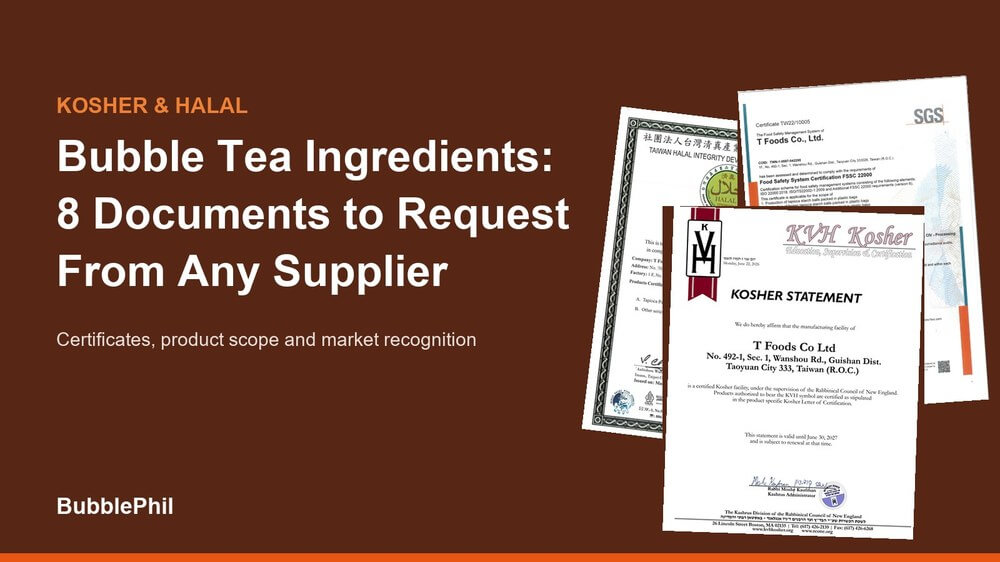
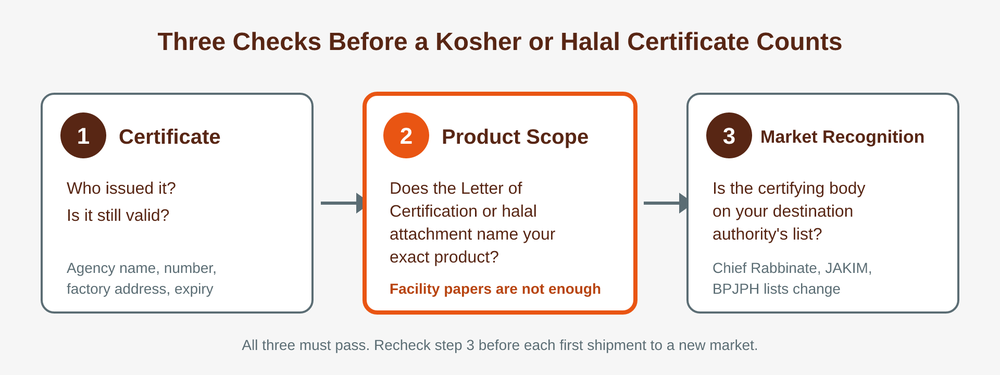
A kosher or halal certificate from a bubble tea ingredient supplier counts in your market only when three things line up: the certificate covers the factory, a product-level document names the exact item you are buying, and your destination authority recognizes the body that issued it. Miss any one of the three and, in markets that regulate these claims such as Israel and Malaysia, the product cannot be sold as kosher or halal, however complete the paperwork looks. The eight documents in the checklist below let you test all three before a first order, and the market table shows where each destination publishes its list of recognized certifying bodies.
Food safety certification and market-access certification are separate checks, and a bubble tea ingredient supplier can pass one without the other. Food Safety System Certification 22000 (FSSC 22000), ISO 22000 from the International Organization for Standardization (ISO) and Hazard Analysis and Critical Control Points (HACCP) confirm that a food safety management system is in place and audited. Kosher and halal certificates confirm that specific products meet religious dietary law, and their value depends on whether your destination market recognizes the issuer.
| Food safety certification | Market-access certification | |
|---|---|---|
| What it proves | A food safety management system is audited | Specific products meet kosher or halal requirements |
| Examples | FSSC 22000, ISO 22000, HACCP | Kosher, halal |
| Who issues it | Accredited certification bodies | Kosher agencies and halal certification bodies |
| Who decides whether it counts | Accreditation bodies and your customer | Your destination authority and your customer |
| Where to check it | IAF CertSearch from the International Accreditation Forum (IAF), or the FSSC 22000 database | The issuing body, then your destination authority's recognized list |
Neither type is an FDA import requirement. Our guide on how to verify a supplier's food safety certification covers the first column step by step. The second column is where the rules change from one destination market to the next.
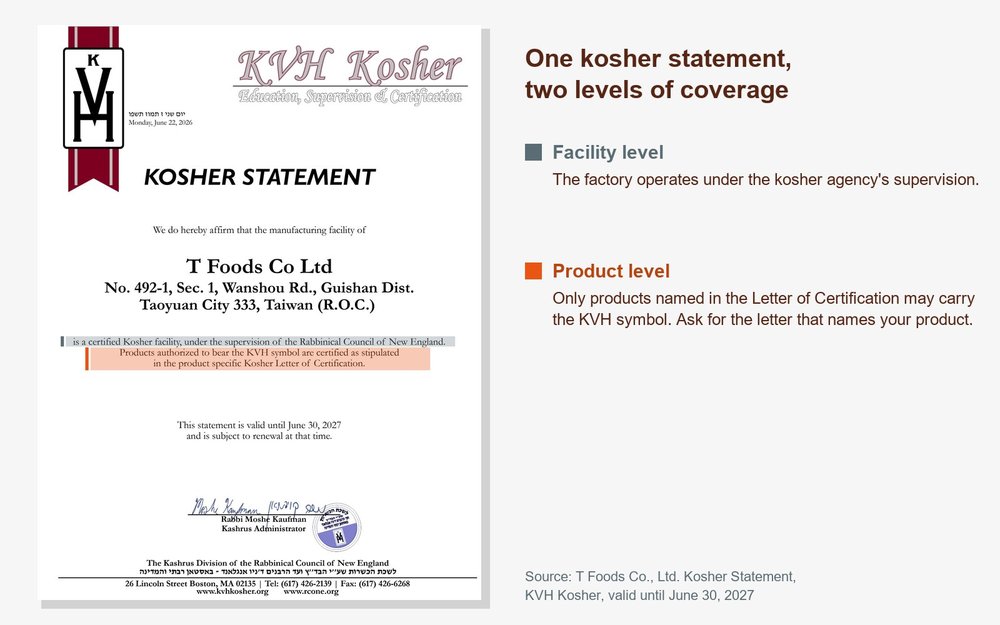
A kosher facility certificate confirms that a factory operates under a kosher agency's supervision, and only the Letter of Certification names the products that may carry the agency's symbol. Agencies issue the two as separate documents because a factory can make certified and uncertified products on the same site. A buyer who files only the facility document has no record that the item on the purchase order is covered.
T Foods' manufacturing facility in Taoyuan, Taiwan, operates under the supervision of KVH Kosher, the kashrus division of the Rabbinical Council of New England. Its current Kosher Statement is valid until June 30, 2027, and the products authorized to carry the KVH symbol are listed in a separate, product-specific Letter of Certification.
Halal certification follows the same structure. The certificate names the holder and the factory, and an attachment lists the certified products. A product that is not on the attachment is not covered, whatever the website or the packaging says about the factory.
Ask every supplier for the Letter of Certification or halal attachment that names your product and brand, not only the facility document. For BubblePhil products, contact us with the product names and we will confirm which certificate covers each one.
Verify a kosher certificate from a bubble tea ingredient supplier by checking five points against the documents and the issuing agency:
A kosher designation tells you which finished products an ingredient can go into, so match it to what you make. Pareve means neither meat nor dairy. Under the Orthodox Union's system, the plain OU symbol marks a kosher pareve product, OU-D marks a product that is dairy or was made on dairy equipment, and OU-DE marks a product made on dairy equipment. The plain OU symbol does not mean kosher for Passover, which carries its own OU-P mark, as OU Kosher's guide to its symbols explains.
| What you make | Designation to check |
|---|---|
| Non-dairy fruit teas, vegan drinks, products sold as pareve | Pareve. One dairy or DE ingredient means the finished product can no longer be labeled pareve |
| Milk teas and chilled dairy desserts | Dairy or pareve ingredients both fit, and the finished product carries a dairy designation |
| Products sold for Passover | Kosher for Passover certification, issued separately from year-round kosher status |
Other agencies use their own symbols for the same categories, so read the designation on the Letter of Certification rather than inferring it from the logo.
Verify a halal certificate for bubble tea ingredients with five checks: the issuing body, the certificate number, the validity date, the product attachment, and recognition in your market. The certificate holder and factory address should match your supplier, and each product you buy should appear by name on the attachment. Confirm the certificate's status with the issuing body using the certificate number.
T Foods' halal certificate, No. CP83901070326, is issued by THIDA and valid until March 29, 2028. It covers 17 products, 14 in the tapioca pearl series and 3 in other series, with the full product list in the certificate attachment. THIDA is on the recognized foreign halal certification body lists of both JAKIM (Malaysia) and BPJPH (Indonesia), and its BPJPH recognition is valid until November 14, 2027. Both lists are updated periodically, so confirm the current listing before your first shipment. BubblePhil's halal certificate page sets out the certificate details.
Each destination market sets its own rule for whose kosher or halal certificate it accepts, and Israel, Malaysia and Indonesia publish the certifying bodies they recognize. The table summarizes five common destinations. Rules were checked on October 27, 2026, and change often, so confirm with the authority before shipping.
| Market | Authority | Kosher or halal rule for imports | Where to check recognition | Who prepares it |
|---|---|---|---|---|
| United States | FDA | No kosher or halal requirement. FDA checks facility registration, prior notice and the importer's supplier verification | Your customer's or retailer's specification | Supplier registers the facility; importer runs supplier verification |
| Israel | Chief Rabbinate of Israel, Import Department | Food imported as kosher needs certification from a Rabbinate-recognized agency and Import Department approval of the product | The Rabbinate's published list of recognized agencies | Importer applies; supplier provides the kosher certificate |
| Indonesia | BPJPH | Foreign halal certificates are accepted through mutual recognition agreements and registered by the importer. Under Government Regulation No. 40 of 2026, halal certification becomes mandatory for imported food and beverages from October 18, 2028 | BPJPH's list of recognized foreign halal bodies | Importer registers the certificate; supplier provides it |
| Malaysia | JAKIM, under the Ministry of Domestic Trade and Cost of Living (KPDN) | Imported food described as halal must be certified by a JAKIM-recognized foreign body, and the product must name that body | JAKIM's recognized foreign halal certification bodies list | Importer or manufacturer marks the certifying body; supplier provides the halal certificate |
| South Korea | Ministry of Food and Drug Safety (MFDS) | No kosher or halal step in the import procedure. The overseas facility must be registered before the import declaration | MFDS | Importer or facility operator |
Tell us your destination market and we will list the documents BubblePhil can prepare for that shipment.
FDA's import requirements for human food include food facility registration, renewed every two years, prior notice before a shipment arrives, the importer's Foreign Supplier Verification Program (FSVP), and English-language labeling. According to FDA's guidance on importing human foods, the agency does not certify or pre-approve individual importers, products, labels or shipments, and kosher and halal certification are not among its requirements. In the U.S. market, kosher and halal status are set by buyers, retailers and foodservice customers, so the certificate your customer names is the one to request.
The Chief Rabbinate of Israel approves kosher food imports on the basis of certification from foreign rabbis and agencies it recognizes, and it does not certify imported products directly. An importer bringing a product in as kosher must hold certification from a Rabbinate-recognized agency and obtain the Import Department's approval for that product, and the label must state that it is kosher with Chief Rabbinate approval under the named agency's supervision, according to the Rabbinate's Import Department. The Rabbinate publishes its list of recognized kashrut agencies, most recently updated in August 2026. In July 2026 the Knesset passed a law restoring the Chief Rabbinate as the sole authority over kosher certificates, The Jewish Chronicle reported on July 16, 2026. Check your supplier's agency against the current list before you order samples.
The kosher certification submitted with an import application must remain valid for at least 45 days from the application date, and the importer also submits photographs of the product and its Hebrew label, plus a manufacturer document such as a certificate of analysis or invoice that confirms the manufacturer's name.
Under Government Regulation No. 40 of 2026, mandatory halal certification for imported food and beverages starts on October 18, 2028, a date BPJPH links to the completion of mutual recognition agreements. The date does not apply to every category: medium and large domestic food and beverage businesses have been covered since October 2024. Foreign halal certificates from recognized bodies are registered by the importer through BPJPH's Halal Information System (SIHALAL), without a new audit, and the product names on the certificate must match the products being imported. THIDA is on BPJPH's list of recognized foreign halal bodies for food, beverages and three other categories, with its recognition valid until November 14, 2027.
Imported food can be described as halal in Malaysia only if it is certified by a foreign halal certification body recognized by JAKIM, and the importer or manufacturer must mark the name of that body on the product. JAKIM appoints each recognized body for three years. THIDA is listed on JAKIM's list of recognized foreign halal certification bodies effective August 21, 2026. Confirm the current listing before your first shipment.
South Korea's import procedure is run by MFDS and centers on food safety rather than religious certification. The overseas manufacturing facility must be registered with MFDS at least seven days before the import declaration, and a declaration filed without that registration is rejected, according to MFDS's imported food safety guidance. MFDS can also inspect overseas facilities on site. Kosher and halal certificates are not part of the MFDS procedure, so a Korean buyer who needs them will name them separately.
Request these eight documents from any bubble tea ingredient supplier before a first order: four certificates that prove coverage, and four shipment documents that prove what is in each batch.
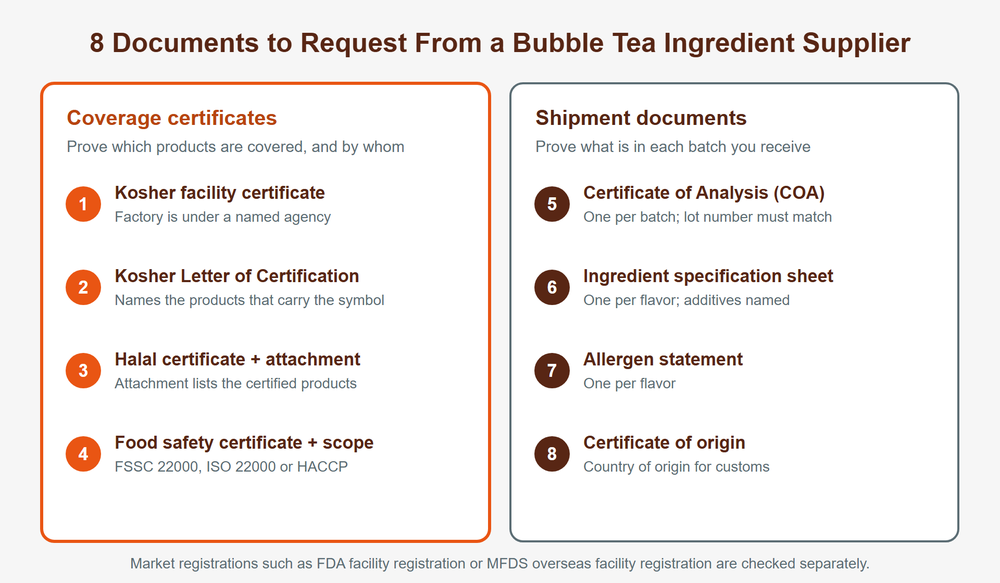
| Document | What it proves | What to check when you receive it | BubblePhil | |
|---|---|---|---|---|
| 1 | Kosher facility certificate, such as a Kosher Statement | The factory is under a named kosher agency's supervision | Agency name, facility address, expiry date | Kosher Statement from KVH Kosher, valid until June 30, 2027 |
| 2 | Kosher Letter of Certification | Which products may carry the agency's symbol | Your product name and brand are listed; dairy, pareve or Passover designation | Shared with buyers for the products they order |
| 3 | Halal certificate with product attachment | Which products are halal certified, and by which body | Certificate number, expiry, your product on the attachment, issuer recognized in your market | THIDA certificate No. CP83901070326, 17 products; attachment shared for the products you order |
| 4 | Food safety certificate with scope | The food safety management system is audited by an accredited body | Standard and version, scope covers your product, validity, database listing | FSSC 22000, ISO 22000 and HACCP from SGS; scope covers tapioca pearls in bags, frozen tapioca pearls in bags, premix powders for snacks, and flavored syrup in bottles |
| 5 | Certificate of Analysis (COA) for each batch | The batch meets its specification | Lot number matches the shipment; results are within specification | Prepared in-house, in line with each destination market's requirements |
| 6 | Ingredient specification sheet | What the product contains | One sheet per flavor; flavorings, colorings and additives named | Prepared in-house, in line with each destination market's requirements |
| 7 | Allergen statement | Which allergens are present | One statement per flavor | Prepared in-house, in line with each destination market's requirements |
| 8 | Certificate of origin | Where the product was made, for customs | Product description, consignee and country of origin | Prepared in-house, in line with each destination market's requirements |
Market registrations such as FDA food facility registration and MFDS overseas facility registration are not documents a buyer collects, so they are not on this list. Ask your supplier which registrations it can support for your market, using the market table above.
Kosher and halal risk in bubble tea ingredients sits in what is added to the base, not in the tapioca starch itself, which is plant-based. The additions that can change a product's status include flavorings with alcohol-based carriers, colorings, emulsifiers, gelatin in some jelly-type toppings, and dairy ingredients, which also change a kosher designation from pareve to dairy.
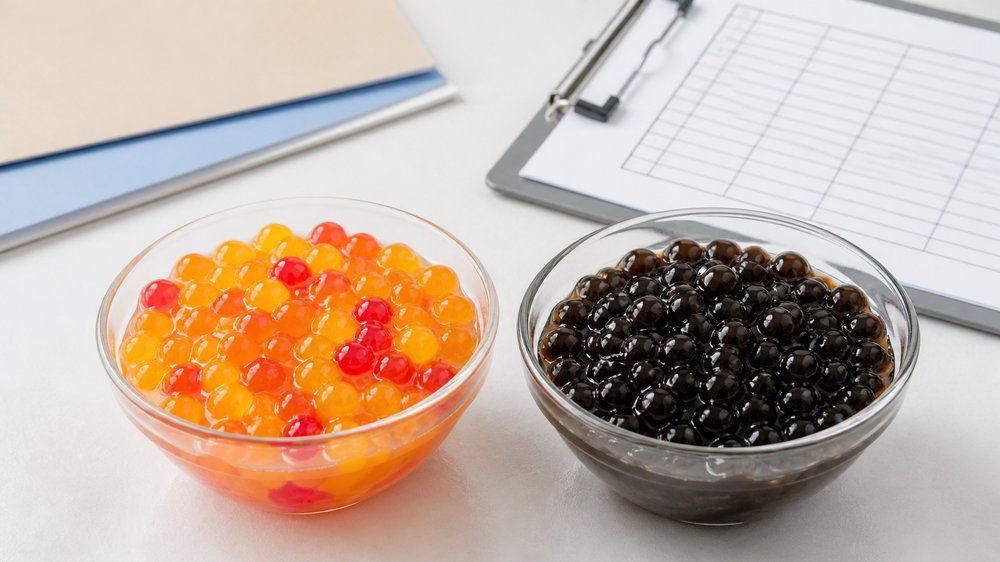
Flavored and colored tapioca pearls carry more of these additions than plain ones. Popping boba has a sodium alginate membrane, a seaweed extract, but its fillings and flavorings vary by flavor. Check the ingredient specification sheet and allergen statement for each flavor, then confirm that each flavor you order appears on the product-level kosher or halal document. Our guide on how to choose a popping boba supplier covers the other checks specific to popping boba.
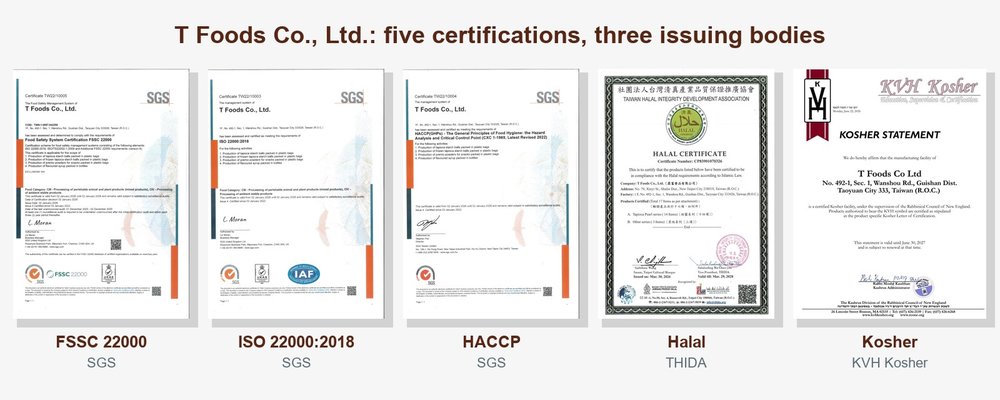
T Foods Co., Ltd., the manufacturer behind BubblePhil, holds five certifications from three issuing bodies, and each one has its own scope.
| Certification | Issuing body | Number | Valid until | Scope |
|---|---|---|---|---|
| FSSC 22000, Version 6 | SGS | TW22/10005 | January 2, 2028 | Tapioca pearls in bags, frozen tapioca pearls in bags, premix powders for snacks, flavored syrup in bottles |
| ISO 22000:2018 | SGS | TW22/10003 | January 2, 2028 | Same four product groups |
| HACCP | SGS | TW22/10004 | January 2, 2028 | Same four product groups |
| Halal | THIDA | CP83901070326 | March 29, 2028 | 17 products; attachment shared for the products you order |
| Kosher | KVH Kosher | Kosher Statement, facility level | June 30, 2027 | Products listed in the Letter of Certification, shared for the products you order |
T Foods prepares the COA, ingredient specification sheet, allergen statement and certificate of origin in-house, in line with each destination market's requirements. The quality management page describes the testing behind them.
Tapioca pearls are made from tapioca starch, which is plant-based, but a tapioca pearl product is kosher only if a kosher agency certifies it. Flavored and colored tapioca pearls depend on their additives, so check the Letter of Certification for the specific product.
Tapioca pearls are starch-based, and popping boba uses a sodium alginate membrane rather than gelatin. Some jelly-type toppings do use gelatin, so check the ingredient specification sheet for each topping. Our popping boba supplier guide covers popping boba ingredients in more detail.
Kosher certification and halal certification are not the same. They follow different religious dietary laws, are issued by different certifying bodies, and are recognized by different authorities, so one certificate cannot stand in for the other.
FDA does not require kosher or halal certification for imported food. Its import requirements cover facility registration, prior notice, the importer's supplier verification and labeling, and FDA does not certify individual products before import. Kosher and halal certification are set by buyers and retailers, and by import authorities in markets such as Israel, Malaysia and Indonesia.
Validity depends on the issuing body, so use the date printed on each certificate. T Foods' Kosher Statement from KVH Kosher is valid until June 30, 2027, and its halal certificate from THIDA is valid until March 29, 2028.
Which BubblePhil products are on which certificate? Kosher and halal coverage is listed product by product, on the Kosher Letter of Certification and the halal certificate attachment, and BubblePhil shares those documents directly with buyers rather than publishing them. Contact us and write two things in the Inquiry Content box: the product names you are considering and your destination market. We will reply with the certificate scope for those products and the document set we can prepare for that market.

Already buying from BubblePhil? Ask your sales contact for the current certificates and attachments for the products you order.
BubblePhil is the international brand of T Foods Co., Ltd., a Taiwan-based bubble tea ingredient manufacturer with more than 30 years in the category. T Foods' facility in Taoyuan, Taiwan produces tapioca pearls, popping boba, flavored syrups, powders and tea bags. The facility is certified to FSSC 22000, ISO 22000 and HACCP for the products in scope, operates under KVH Kosher supervision, and holds halal certification from THIDA for the products listed on its certificate. BubblePhil supplies bubble tea chains, beverage and dessert operators, distributors, importers and private label partners across 19 markets.