A popping boba supplier is a manufacturer that produces popping boba (small juice balls with a fruit-flavored syrup center sealed inside a thin sodium alginate membrane) and ships them sealed and ready to serve. On paper, most popping boba suppliers look alike: similar certificates, similar flavor lists, similar price sheets. The differences that cost you money only show up later: how many popping pearls arrive broken, how much of each tub is product rather than packing syrup, and whether the fruit flavor comes through clearly. You can check all three with a single sea-freight sample shipment before you commit to a commercial order.
Six facts frame every popping boba sourcing decision, and you can verify each one against a supplier's own specification sheet:
A popping boba supplier runs a popping boba production line built on spherification, a liquid process that has almost nothing in common with the starch-dough line used to make tapioca pearls. Tapioca pearls start as a kneaded cassava starch dough that is formed and dried, so quality hinges on starch, moisture and cooking performance. Popping boba starts as a fruit-flavored syrup base. Drops of that base fall into a setting bath, where sodium alginate reacts with calcium to form a thin membrane around each drop, and the finished juice balls are then packed in liquid. Depending on the market, the same product is sold as popping boba, bursting boba, popping pearls or juice balls; the name changes, but the process does not. For a full product-level comparison, our guide to popping boba vs. tapioca pearls sets out ingredients, texture and menu fit side by side.
For buyers, the practical takeaway is simple. A factory that makes excellent tapioca pearls has not yet proven anything about its popping boba, because the two products fail in different ways. Tapioca pearls fail in the kitchen, when they cook unevenly or harden too quickly. Popping boba fails in transit and in the cup, when membranes rupture in the tub or the flavor falls flat.
That difference also raises the question of who actually makes the product. Plenty of companies that list popping boba do not operate a popping boba production line at all; they buy finished tubs from a manufacturer and resell them under their own brand. Trading is a legitimate business, but it means the company quoting you cannot answer process questions first-hand. Ask one direct question early on: where is the production line, and can you see it?
BubblePhil's manufacturing partner, T Foods Co., Ltd., produces popping boba, tapioca pearls, syrups, powders and teas on its own lines in Taoyuan, Taiwan, so topping orders and base ingredient orders come from the same facility on the same production schedule.
If you plan to source both products from one company, confirm that the supplier's certification scope covers both product categories, not just the one being quoted. Our tapioca pearl supplier guide makes the same point from the tapioca pearl side. Confirming that the line exists is step one; the next question is what the people running it actually control.
A popping boba manufacturer controls five variables that determine how each popping pearl performs in the cup: membrane thickness, the filling's syrup base and juice content, sugar level, size consistency, and how each tub is filled and sealed. A specification sheet should state the result for each one, and a capable supplier can explain how each is set.
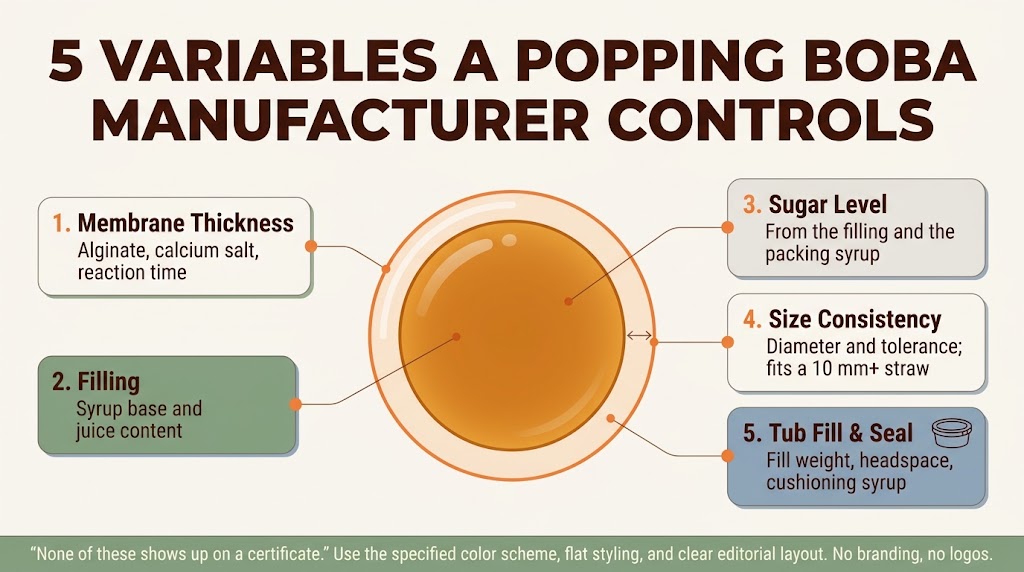
Membrane thickness depends on three things: the concentration of sodium alginate, the concentration of the calcium salt it reacts with, and how long the two react before the popping boba is rinsed. The longer the reaction runs, the thicker the membrane. That creates the central trade-off in popping boba manufacturing. A thicker membrane holds up better to sea freight, stacking and ice, but it has a chewier bite and can leave a noticeable skin. A thinner membrane delivers a cleaner burst but breaks more easily in the tub.
There is no single correct thickness. A beverage chain that serves drinks within minutes of preparation can accept a thinner membrane than a distributor whose stock spends weeks at sea and months in a warehouse, so tell your supplier which scenario you are buying for.
The filling is where popping boba gets its fruit flavor. BubblePhil popping boba uses a syrup-based filling: real fruit juice makes up less than 6% of it, and the syrup carries the fruit flavor. Formulations vary from supplier to supplier, so ask each one to state the juice content on its specification sheet. You may need that figure for your own menu or labeling claims, and it puts every quote on the same footing. A supplier that formulates its own fillings will know the number; a supplier that cannot provide it either does not make the product or would rather you did not compare.
Popping boba adds sugar to a drink from two sources: the syrup in the filling and the syrup it is packed in. If you standardize drink recipes to a set sweetness level, you need that figure, because a 40–60 g serving of popping boba changes the sweetness of the whole cup. Ask for sugar content per 100 g as a written specification, not a description.
Size determines whether popping pearls pass smoothly through the straw. BubblePhil recommends serving popping boba with a wide boba straw of 10 mm diameter or more, and consistent sizing is what makes that recommendation work in practice. Ask for the diameter specification and its tolerance.
How full each tub is, and how much syrup surrounds the popping pearls, determines how much they knock against each other in transit. Ask how the supplier sets fill weight and headspace, and whether it adjusts the packing for long sea routes.
For custom popping boba orders, T Foods can adjust flavor, color, texture and packaging, each of which maps directly to the variables above.
None of these variables shows up on a certificate, which is why certification is the first filter you apply but never the only test you rely on.
A popping boba supplier should hold a recognized food safety certification, such as Food Safety System Certification (FSSC) 22000, ISO 22000 or Hazard Analysis and Critical Control Points (HACCP), with a certified scope that names popping boba, plus any dietary certification your market requires. Scope is the part most buyers overlook. A certificate covers a specific site and a specific list of products, not everything a company sells.
Tier 1 is the documentation any qualified popping boba supplier should be able to produce on request:
Tier 2 is the documentation that turns a certificate into evidence about the specific product you are buying:
T Foods' facility in Taoyuan, Taiwan holds HACCP, ISO 22000:2018 and FSSC 22000 (Version 6) certification, all issued by SGS and continuously maintained since 2022. BubblePhil's sales team can provide certificate numbers and the certified scope on request, and buyers can check T Foods' FSSC 22000 status directly in the public database at fssc.com. Our guide to verifying a supplier's food safety certification explains how to confirm that a certificate is genuine, current and covers the products you buy.
Popping boba's membrane is set with sodium alginate, a seaweed extract, rather than gelatin, so its base structure contains no animal-derived ingredients. At the ingredient level, that makes popping boba a natural fit for halal, vegetarian and vegan menus, and it is one reason popping boba adapts easily to markets where gelatin-based toppings are off the table.
An ingredient fact is not a certification, however. If your market requires halal certification, ask the supplier for the certificate itself and check that popping boba appears in its scope. Apply the same check to vegan claims: ask for the allergen statement and ingredient specification for each flavor, because fillings and colors vary by flavor even when the membrane does not.
T Foods also holds halal certification from the Taiwan Halal Integrity Development Association (THIDA), covering the products listed on the certificate. The certificate is published on our halal certification page; check with our sales team whether the items you plan to order are on that list.
Certification tells you that a food safety system exists and covers your product. It tells you nothing about how many popping pearls survive the journey, and that is where popping boba quality is decided.
Popping boba quality comes down to five measurements that have no equivalent in tapioca pearls: membrane integrity, burst rate on arrival, flavor authenticity, color stability, and drained weight. Ask suppliers for their specification on each, then verify them yourself.
T Foods' in-house laboratory tests every batch at three points: incoming raw materials, in-process goods and finished product before shipment. Testing covers microbial counts, mold and yeast, allergen screening, moisture content and dimensional specifications, and SGS audits the laboratory independently every year. BubblePhil's quality management page describes the full protocol. The five measurements below are what a popping boba buyer should check on top of any supplier's general testing.
Membrane integrity is the ability of each popping pearl to hold its shape through handling, ice and carbonation, and still burst cleanly when bitten. Test it the way your customers will experience it: make the actual drink, with ice, at your normal serving temperature, and check the popping pearls after the drink has stood for a realistic length of time. A popping boba membrane that holds in still tea but splits in a sparkling base points to a formulation problem, not a handling one; BubblePhil's popping boba membrane is designed to hold up in carbonated drinks, sparkling fruit sodas and slushies.
Burst rate on arrival is the share of popping pearls that reach your warehouse already broken. Open a sample of tubs from each delivery, count the broken popping pearls in a measured portion, and log the result by lot. Ask the supplier how each tub is packed to protect the popping boba in transit, and what its arrival track record looks like. With BubblePhil popping boba, the syrup in each tub cushions the popping pearls during shipping. No arrival breakage issues have come up under normal shipping conditions, so T Foods does not set a separate breakage threshold.
Flavor authenticity determines whether the burst delivers a clear, recognizable fruit flavor or little more than sweetness. In a syrup-based filling, the syrup carries the fruit flavor, so juice content alone will not tell you how a flavor tastes in the cup. Run a blind tasting of the same flavor from each candidate in your own base drink, starting with the flavors you plan to put on the menu.
Color stability is whether a popping boba flavor keeps its color throughout its 12-month shelf life and once it is in the drink. Part of popping boba's appeal is color suspended in a clear cup, so a flavor that fades or bleeds into the drink loses its value on the menu. Keep a retained sample from your first delivery and compare it against later deliveries, and against itself as it ages.
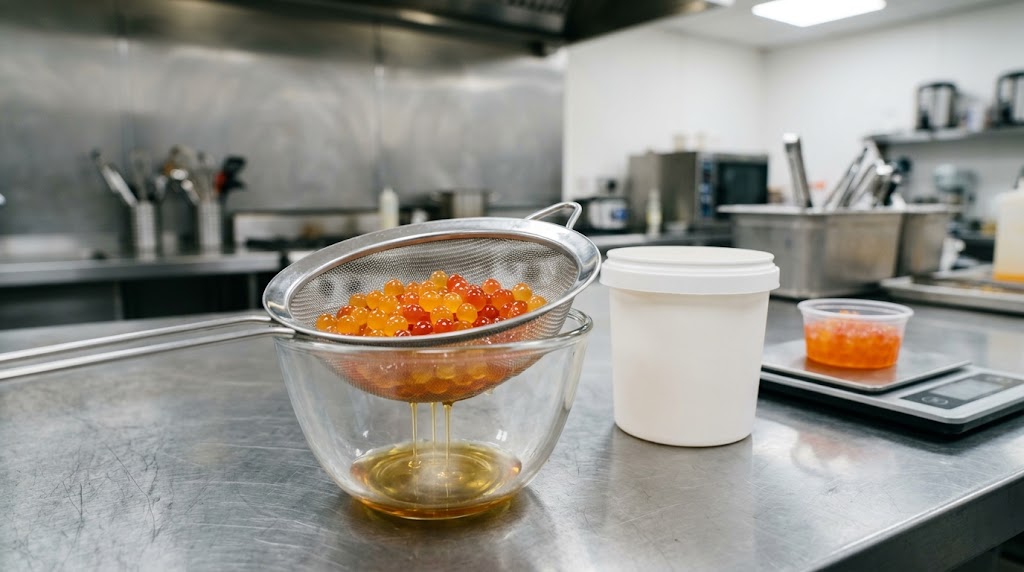
Drained weight is the weight of the juice balls left in a tub after the packing syrup is poured off, and it is the figure that actually determines your cost per serving. Two suppliers can both sell 3.4 kg tubs and deliver very different amounts of usable popping pearls. Ask for the drained weight specification, verify it on arrival, and calculate cost per serving by dividing the tub price by the number of 40–60 g servings the drained weight yields.
All five measurements depend on what happens between the factory gate and your warehouse, which makes shipping as much a quality issue as a logistics one.
Popping boba ships at ambient temperature: unopened tubs keep for 12 months at 4°C to 25°C, so a full order can travel by sea and be stored in a warehouse without a cold chain. That is a real purchasing advantage over frozen toppings, including frozen instant tapioca pearls, which need temperature-controlled freight and storage all the way from the factory to the store.
BubblePhil popping boba uses the same pack format for every flavor:
| Item | Specification |
|---|---|
| Pack format | 3.4 kg × 4 tubs per carton |
| Shelf life, unopened | 12 months |
| Storage, unopened | 4°C to 25°C, away from direct sunlight |
| After opening | Refrigerate immediately and use promptly |
| Country of origin | Made in Taiwan |
| Export documents | COA, ingredient specification sheet, allergen statement, certificate of origin |
Because every flavor shares that format, a single purchase order can cover the full popping boba range, and it can be consolidated with tapioca pearls, syrups and tea bags in one less-than-container load (LCL) or full container load (FCL) shipment. For importers still learning which flavors sell in their market, that means you do not have to choose between ordering too few flavors and overstocking each one.
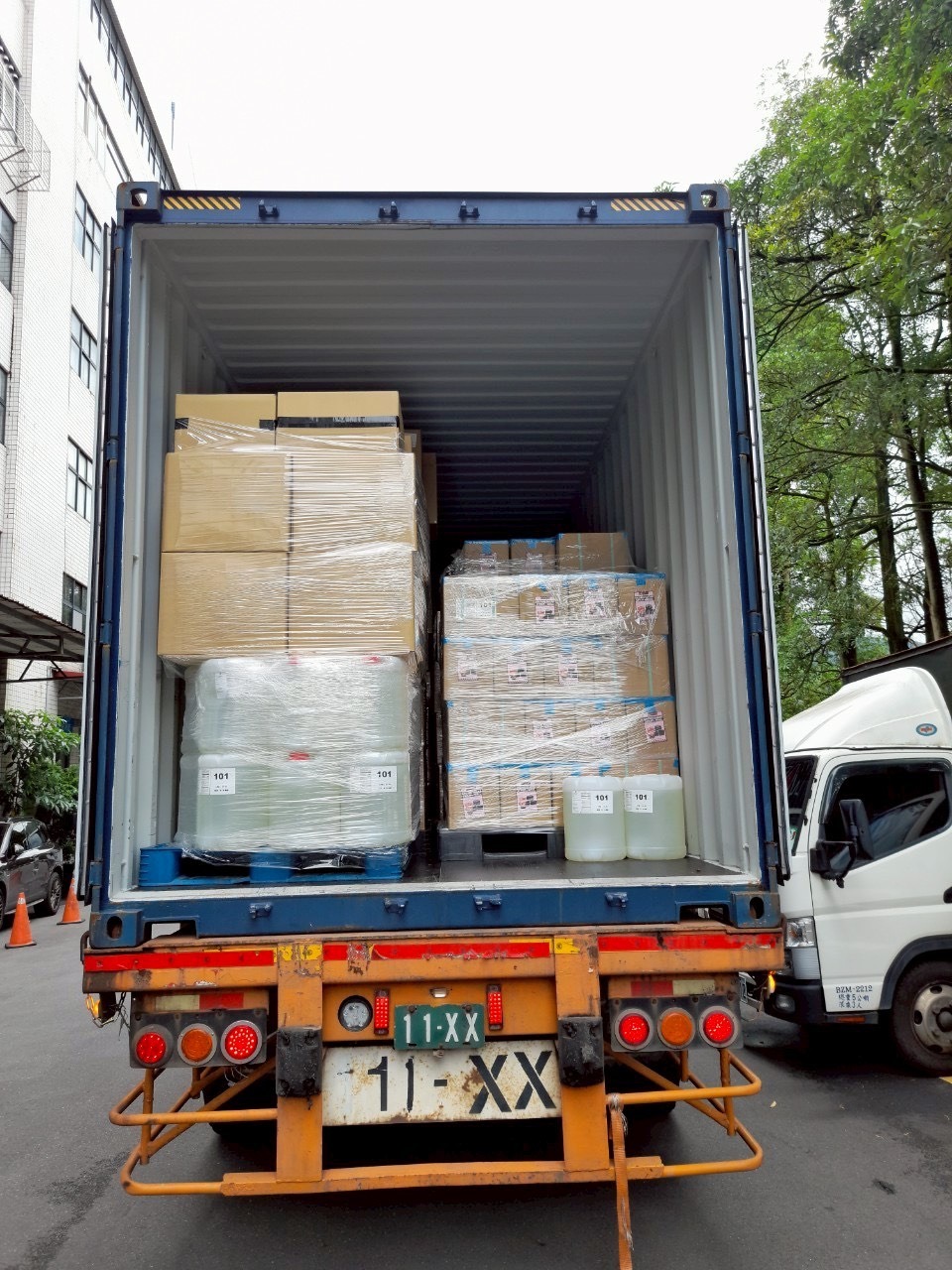
A 12-month unopened shelf life means a sea shipment still reaches your customers with most of its shelf life remaining, but only if the stock was fresh when it was loaded. Ask for the production date on every carton, and agree on a minimum remaining shelf life at loading before you sign.
The 25°C storage ceiling is the one figure in this table worth discussing for long routes. Ask your supplier what it recommends for summer shipments through hot regions, and whether it has had problems on those lanes.
Full specifications for each flavor are listed on BubblePhil's popping boba supplier page. Once logistics are settled, the next decision is how many flavors to include in your first order.
Most new buyers should start with three to five popping boba flavors and expand once sell-through data shows which ones move in their market. Opened tubs need refrigeration and prompt use, so every extra flavor on a menu means another open tub competing for fridge space and another source of waste.
BubblePhil's 15 popping boba flavors fall into five series, and a starting range works best when it draws from different series rather than doubling up on one:
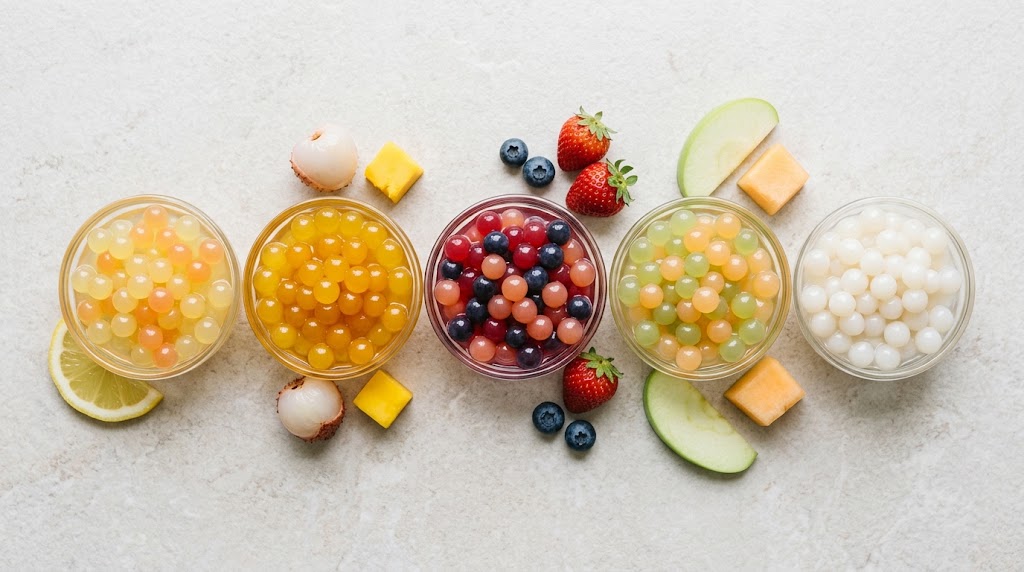
A practical four-flavor starter set takes one flavor from each of the first three series and adds one lighter or creamy option: for example, Lemon, Mango, Strawberry and Lychee, or Yogurt instead of Lychee for a menu built around milk and cultured drinks.
The right number of flavors also depends on who is buying. A bubble tea chain should keep its starting range tight and standardize it across locations, so every store can use up an opened tub within the same window. A distributor is better off ordering a wide range on the first container and narrowing it on the reorder, since a mixed-flavor load packs and ships the same way as a single-flavor one. A private label buyer can go beyond the standard range entirely: BubblePhil develops custom flavor profiles and packs them under the buyer's own brand, in bulk tubs or in retail cup formats for supermarket shelves and e-commerce.
Choosing flavors defines the order. The evaluation process tells you whether the supplier behind it can deliver that order consistently.
Evaluate a new popping boba supplier in four stages (desk research, documentation review, transit-realistic sample testing and a production audit), and treat sample testing as the deciding stage. The structure follows the framework in BubblePhil's tapioca pearl supplier guide, but the tests in Stage 3 are specific to popping boba.
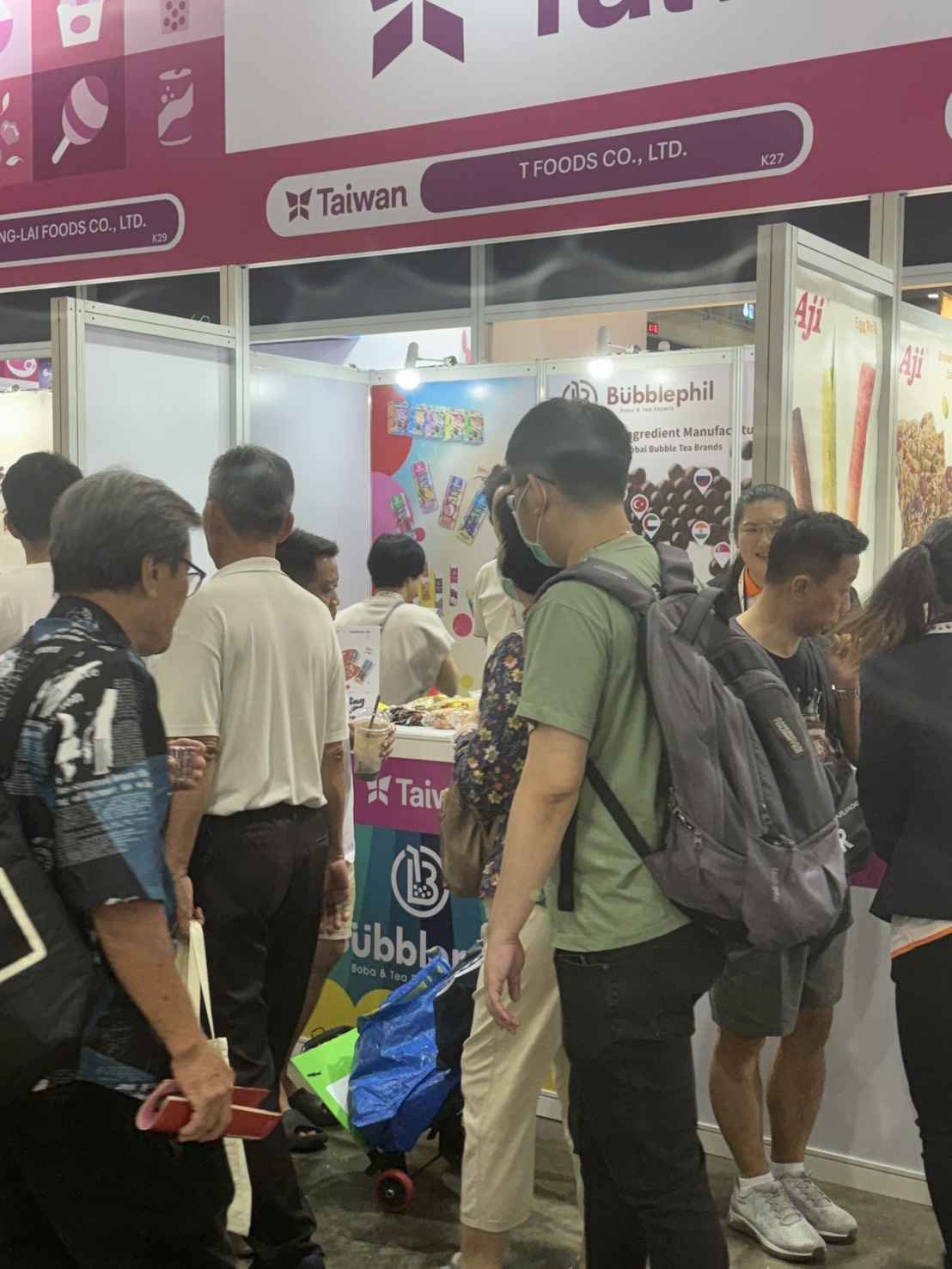
Build a shortlist of five to eight candidates from trade shows, B2B directories and referrals, then narrow it down to those that manufacture popping boba themselves. The fastest filter is a single question about the popping boba production line: where is it, and can a buyer see it running?
Collect every Tier 1 and Tier 2 document from each candidate and check the certificate scope line by line. A popping boba supplier whose certificate lists only tapioca pearls, or only the parent company, has not yet shown that its popping boba is covered.
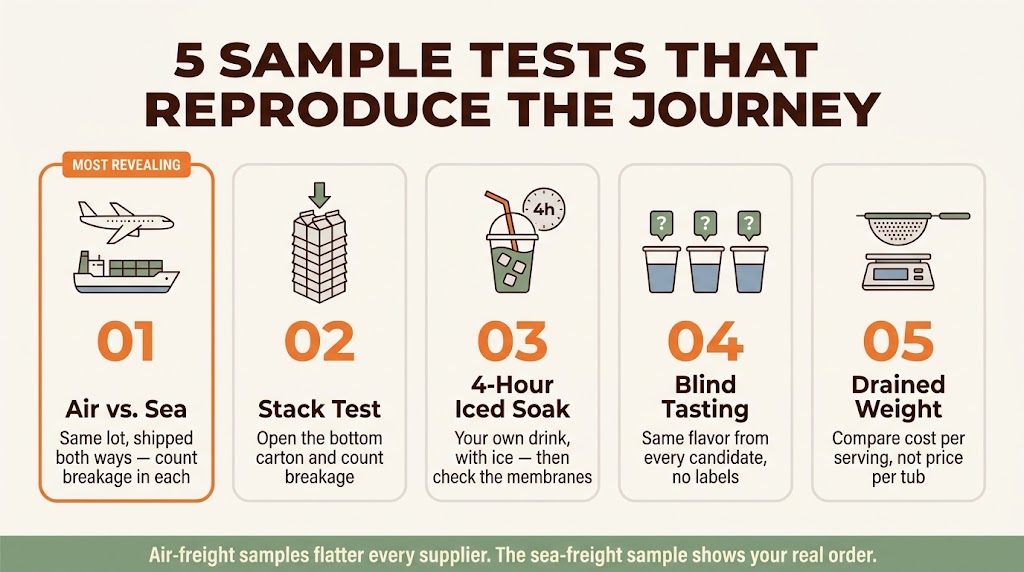
Popping boba sample testing has to replicate the journey, not just the taste. Five tests cover it:
BubblePhil's Collaboration Process page explains how sampling rounds, specification adjustments and lead times work.
Before making any supplier your primary source, audit the popping boba line itself, either on-site or through a third-party auditor. Observe the setting bath, rinsing, filling and sealing, and ask to see the batch coding and retained-sample program. If a supplier welcomes the audit but keeps steering you toward its tapioca pearl or syrup lines, ask again to see the popping boba line specifically.
Most of the problems this process catches have recognizable early warning signs, and some appear before a single sample ships.
Six warning signs are specific to popping boba sourcing, and each one points to a weak process or a product the supplier does not control:
A popping boba manufacturer should be able to tell you how each tub is packed to protect the popping boba on its way to you, and what its arrival track record looks like. A supplier that cannot answer either question has not thought through the part of the journey where popping boba is most vulnerable.
Small air-freight sample packs arrive within days and rarely break. A supplier that will not send a sea-freight sample, or a full tub instead of a pouch, is keeping the most important test off the table.
Juice content belongs on a popping boba specification sheet, whatever the figure is. A supplier that will not disclose it is asking you to buy without a number your own menu or labeling claims may depend on.
A tub that drains down to far fewer popping pearls than a competitor's tub is selling packing syrup at popping boba prices. Weigh the drained popping pearls; the label weight alone tells you nothing.
Some popping boba ranges list dozens of flavors that taste almost identical once you look past the color. Taste three flavors side by side without looking at them. If you cannot tell them apart, the flavor count is a catalog number, not a real product range.
Any shelf-life claim should be backed by stability testing. BubblePhil popping boba carries a 12-month unopened shelf life; a supplier claiming longer should be able to show the data, and one that cannot is taking a gamble on your behalf.
None of these signs alone proves that a supplier is unsuitable, but two or more together are a reason to stop at Stage 2 rather than spend money on Stage 3.
Below are the questions bubble tea buyers, chains and distributors ask most often when sourcing popping boba:
Popping boba's membrane is made from sodium alginate, a seaweed extract, so its base structure contains no animal-derived ingredients. Fillings vary by flavor, however, so check the ingredient specification and allergen statement for each flavor before labeling a drink vegan.
No. Popping boba's membrane is set with sodium alginate from seaweed, not gelatin. That is the main structural difference between popping boba and gelatin-based jelly toppings.
Check the allergen statement for each popping boba flavor rather than assuming. The sodium alginate membrane is not grain-based, but fillings and flavorings differ between products and suppliers.
Popping boba has no gelatin in its membrane, which removes the most common halal concern with toppings. Halal certification, however, is issued for specific products, so ask the supplier for its halal certificate and confirm that popping boba is listed. T Foods holds halal certification for the products listed on its certificate, and our sales team can confirm which items it covers.
Unopened popping boba keeps for 12 months when stored at 4°C to 25°C, away from direct sunlight. Once a tub is opened, refrigerate it immediately and use it promptly.
Not before opening. Sealed popping boba is shelf-stable at ambient temperature, which is why it can be shipped and warehoused without a cold chain; refrigeration is only needed once the tub is opened.
BubblePhil recommends 40–60 g of popping boba per cup, adjusted for cup size and food cost targets, served with a wide boba straw at least 10 mm in diameter.
Contact BubblePhil's sales team for the minimum order quantity (MOQ); for custom and private label projects, MOQ varies by project. Mixed-flavor pallet configurations are available, so new customers can trial the full flavor range before committing to larger volumes.
Usually, yes, as long as the manufacturer runs every flavor on one line. All BubblePhil popping boba flavors share the same specification and pack format, so a single order and a single container can carry any combination of flavors.
Most established manufacturers do. BubblePhil develops custom popping boba flavors and packs them under the buyer's own brand, in bulk cartons for foodservice or in cup and single-serve formats for retail and e-commerce.
Expect a Certificate of Analysis, an ingredient specification sheet, an allergen statement and a certificate of origin with each shipment, plus copies of the supplier's food safety certificates showing popping boba in scope. Your destination market may have additional registration or labeling requirements.
Yes, and consolidating the two simplifies purchasing and lets both products ship in one container. Confirm that the supplier's certification scope covers both product categories, and evaluate each product on its own terms: tapioca pearls on cooking performance, popping boba on breakage and drained weight. Our tapioca pearl supplier guide covers the tapioca pearl side.
Choosing a popping boba supplier comes down to five steps, in this order:
Buyers who stop at step 2 often discover breakage and flat-tasting flavors in their first commercial container. Buyers who complete all five find out from a sample shipment instead, which is the cheapest place to learn.
BubblePhil is the international brand of T Foods Co., Ltd., a Taiwan-based bubble tea ingredient manufacturer with more than 30 years in the category. T Foods' facility in Taoyuan, Taiwan produces BubblePhil's popping boba in 15 flavors, alongside tapioca pearls, flavored syrups, powders and tea bags. The facility is certified to FSSC 22000, ISO 22000 and HACCP, T Foods holds halal certification for the products listed on its certificate, and its in-house laboratory runs three-stage testing with an annual third-party audit by SGS. BubblePhil supplies bubble tea chains, beverage and dessert operators, distributors, importers and private label partners across 19 markets.
To put this framework into practice, browse BubblePhil's popping boba range, review our quality management and testing protocol, or contact us to request specifications, certificate details and samples.