Quality certification (FSSC 22000, ISO 22000, HACCP, HALAL) is the first filter when evaluating a tapioca pearl supplier — but certification alone does not guarantee batch-to-batch consistency.
A structured four-stage evaluation — documentation review, sample testing, factory audit, and ongoing performance review — catches problems a certificate alone won't show.
Whether you're a bubble tea brand scaling across 50 locations, a buyer sourcing for a regional chain, or a distributor building a product portfolio, you face the same constraint: the global bubble tea market is projected to surpass USD 5.3 billion by 2027. Tapioca pearls are the category's most recognizable ingredient — and, in the kitchen, its most demanding one. The tapioca pearl supplier you choose determines product consistency, customer satisfaction, and margin — directly and immediately.
Supplier selection in the boba industry stays under-documented for a simple reason: most guidance is anecdotal or buried behind trade-publication paywalls. This guide is structured differently. It is built on certification standards, sourcing patterns observed across bubble tea ingredient categories worldwide, and the qualification framework BubblePhil applies when working with its own manufacturing partner — giving you a methodology for evaluating, comparing, and onboarding a cassava pearl supplier that matches your brand's scale and quality standards.
Tapioca pearls — also called boba or QQ pearls — are spherical chewy balls made primarily from cassava starch, water, and in many formulations, caramel coloring or sweetener.
They are the textural centerpiece of bubble tea and shape the customer experience in every cup. A pearl that is too hard, too mushy, inconsistently sized, or that loses its chew within 90 minutes of cooking signals a failure somewhere upstream in the supply chain — not a one-off batch issue.
Tapioca pearls are unusually sensitive to manufacturing variables for a beverage ingredient. Starch source quality, moisture content during extrusion, particle size consistency, and the ratio of cassava starch to other starches all affect elasticity, cook time, and holding time. Two suppliers selling "standard black tapioca pearls" at the same price point can produce noticeably different results once the pearls reach your kitchen — a pattern explored in more depth in our guide to tapioca pearl types and formats.
Inconsistency multiplied across hundreds of locations is an enterprise-scale problem. A single bad batch can cost an independent shop a loyal customer. Either way, the supplier relationship functions less like a commodity purchase and more like a technical partnership — one that requires the same qualification rigor a brand would apply to any process that touches every cup it sells.
Qualification starts with documentation, not samples.
Before requesting a product trial, a serious tapioca pearl supplier should be able to produce the following credentials without hesitation or delay.
A qualified manufacturer treats this documentation as a baseline, not a negotiating point. If a supplier resists sharing any item on either list, treat that as a disqualifying signal — regardless of price or how long the relationship has existed.
BubblePhil's manufacturing partner, T Foods Co., Ltd., holds all four Tier 1 certifications — FSSC 22000, ISO 22000, HACCP, and HALAL — each maintained through annual renewal and independent third-party audit. The next section explains why certification alone is only half the qualification picture.
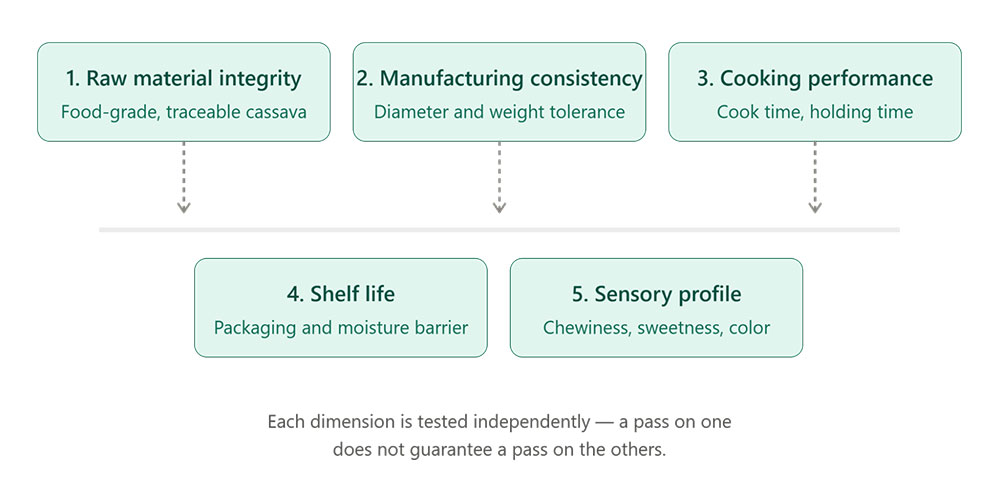
Quality in tapioca pearls is evaluated across five dimensions: raw material integrity, manufacturing consistency, cooking performance, shelf life, and sensory profile.
The cassava root used must be food-grade, sourced from approved agricultural regions, and free from aflatoxin contamination. Ask any supplier for their raw material sourcing policy — and specifically whether incoming ingredient testing happens independently, or only on the supplier's own assurance.
Pearl diameter tolerance should not exceed ±1mm for standard 8mm black pearls. Weight per unit should hold within a 5% variance. Ask whether extrusion line calibration logs and QC sampling frequency are documented — and whether you can see a sample of that documentation before placing an order.
This is where many brands under-invest in rigor. Cooking performance testing should measure optimal cook time, holding time at target texture, acceptable temperature range, and behavior across different water mineral content levels. A supplier with genuine R&D capability provides cooking performance data sheets — and can explain, not just report, what happens when conditions deviate from the standard test environment.
This matters more than it might appear on a spec sheet. A multi-location bubble tea chain in Mexico discovered this directly: pearls that cooked correctly in lab conditions still came out hard at the center in their kitchens. The root cause turned out to be altitude — water boils at a lower temperature at elevation, and the standard pearl formulation in use was not adjusted for that thermal environment. The fix required reformulating starch ratios and heat penetration characteristics for the client's specific operating conditions, not simply cooking longer.
Dried tapioca pearls typically hold for at least 6 months when stored in a cool, dry environment away from direct sunlight, though shelf life varies by destination market's food regulations. Two packaging factors drive most of that variance:
Packaging design and material selection therefore matter as much as the pearl formulation itself when it comes to maintaining stability through storage and distribution — particularly for buyers shipping across multiple climate zones or relying on longer ocean freight routes, a problem covered in more detail in BubblePhil's work with a European distributor.
Suppliers should offer samples across a defined range of chewiness (measured by texture analyzers, not description alone), sweetness level, and color stability after cooking.
Geography is a useful first filter — but it is not the one that determines consistency. That comes down to what happens inside the factory, batch by batch.
The three dominant production regions — Taiwan, Thailand, and Vietnam — each carry a distinct quality and cost profile, shaped largely by how long each has had a certified, export-grade manufacturing base. But "made in Taiwan" or "FSSC 22000 certified" is a starting filter, not a finish line: certification confirms a system exists, not that every batch performs identically. The more reliable question is what a specific manufacturer actually tests, batch by batch — a point covered in detail under Food Safety Certification below.
Taiwan is the birthplace of bubble tea and retains a reputation for premium-quality tapioca pearls, built on decades of production refinement. Taiwanese pearls typically command a 20–40% price premium but offer superior QQ texture consistency and broader international certification portfolios. They are the default choice for premium and luxury bubble tea concepts.
Thailand is the world's largest cassava producer, giving Thai tapioca pearl suppliers a structural cost advantage. Thai manufacturers have upgraded their food safety infrastructure substantially over the past decade, with many now holding FSSC 22000 and export approvals for major markets. Thai pearls offer competitive pricing and improving quality consistency.
Vietnam's tapioca pearl manufacturing sector has grown quickly since 2018, driven by lower labor costs. Vietnamese suppliers generally offer the lowest price points, with greater variance in quality consistency between factories. This tier suits cost-sensitive applications where the buyer has strong internal QC capability to compensate for supplier-side variability.
The figures below represent general market ranges, not a single supplier's published pricing — use them to calibrate expectations, then verify against actual quotes and documentation.
| Criteria | Premium Taiwanese | Mid-Market Thai | Budget Vietnamese |
|---|---|---|---|
| ISO 22000 / FSSC | Standard | Common | Variable |
| HACCP Certified | Yes | Yes | Sometimes |
| Export-Market Registered | Yes | Most | Some |
| HALAL Certified | Yes | Yes | Some |
| Min. Order Quantity | 500kg–1MT | 300kg–1MT | 200kg–500kg |
| Lead Time | 2–4 weeks | 3–5 weeks | 4–6 weeks |
| Holding Time (cooked) | 5–6 hours | 4–5 hours | 2–4 hours |
| OEM/Private Label | Yes | Yes | Some |
| COA per Batch | Yes | Yes | Inconsistent |
| Typical Yield Rate | 90–94% | 85–92% | 75–88% |
Data represents general market ranges as of 2025–2026. Individual supplier performance may vary.
Inside the "Premium Taiwanese" tier, the gap between suppliers is rarely about the raw material — it is about how rigorously each one tests it. BubblePhil's manufacturing partner, T Foods Co., Ltd., runs raw materials, in-process goods, and finished products through three separate testing stages before any batch ships, verified independently rather than taken on a supplier's word, and backed by annual third-party audit through SGS. That is the difference a certification line item on a comparison table cannot show on its own.
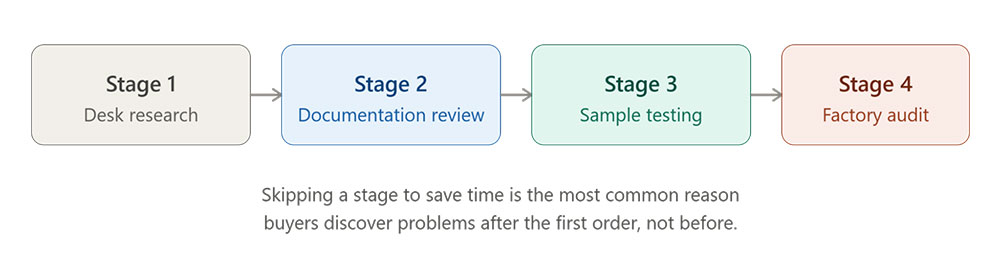
The evaluation process works best as a structured four-stage sequence — skipping a stage to save time is the most common reason buyers discover problems after the first commercial order, not before.
Compile 5–8 candidate suppliers using trade directories (Alibaba, Global Sources, Made-in-China), industry trade shows (Taiwan Excellence, THAIFEX, Food Ingredients Asia), and buyer network referrals. Screen against your non-negotiable certification checklist to narrow the list to 3–4 qualified candidates.
Request and systematically review every Tier 1 and Tier 2 document. Use a standardized scoring rubric so suppliers are compared on the same basis, not on how persuasive their sales materials are. Document any gaps and issue formal clarification requests before moving forward.
Request standardized sample quantities — at least 2kg for meaningful testing. Run cooking tests at your actual production facility, using your own water source and equipment, not the supplier's lab conditions. Test across multiple batches from the same supplier to assess batch-to-batch consistency, and involve your kitchen team directly in the sensory evaluation.
For any supplier you intend to make a primary source, conduct or commission a factory audit before the first commercial order. Audit scope should cover facility hygiene and GMP compliance, raw material storage and handling, production line controls, laboratory testing capabilities, and traceability systems. If an on-site visit isn't feasible, a credible third-party audit — SGS, Bureau Veritas, or Intertek — is an acceptable substitute.
The following is an illustrative scenario based on common outcomes when this four-stage framework is applied — not a named BubblePhil client engagement.
A regional bubble tea chain operating 120 locations across Southeast Asia was sourcing standard black tapioca pearls from a single supplier at USD 11.50/kg, and facing margin pressure with no clear lever to pull.
MOQs typically range from 200kg to 1 metric ton per order, depending on the supplier's production scale. Smaller operators can often negotiate lower MOQs with regional distributors rather than direct factory orders.
Higher-quality pearls hold their texture for 4–6 hours after cooking. Lower-quality pearls may start losing their chew within 90–120 minutes, which is one of the clearest practical signals of raw material or formulation quality.
Yes. Most established manufacturers offer OEM/ODM services, typically starting at 500kg–2MT per SKU. Lead times for custom formulations run longer than standard products, so factor that into launch planning.
Standard black tapioca pearls made from pure cassava starch are naturally vegan and gluten-free. Always verify allergen declarations and cross-contamination protocols directly with the supplier rather than assuming based on the base ingredient alone.
Contact the certification body directly, using contact details from the certification body's own official website — not a link the supplier provides. For US-bound shipments, verify registration through the relevant national authority's official portal.
Payment terms vary by order size, supplier policy, and trading history between the two parties — first-time orders typically require a larger upfront commitment than established relationships. Confirm specific terms directly with each supplier rather than assuming a single industry-wide standard applies.
Store in a cool, dry environment below 30°C (86°F), away from direct sunlight. Once opened, reseal tightly and refrigerate, and aim to use the product within 3 days of opening to preserve texture and freshness.
Lead times range from 2–6 weeks depending on supplier location, order volume, and production capacity. Add 1–3 weeks for customs clearance when importing internationally.
Yes, and for any supplier you're considering as a primary source, you should. Reputable manufacturers welcome buyer facility visits — schedule at least 4–6 weeks in advance to align with production calendars.
FDA registration of the foreign facility is required, and the facility should comply with the FSMA Foreign Supplier Verification Program (FSVP).
Most mid-to-large manufacturers offer private label services above a defined order threshold, including custom bag design and proprietary recipe formulations.
Start with industry trade shows — THAIFEX Anuga Asia (Bangkok), Food & Hotel Asia (Singapore), or the Taipei International Food Show — and supplement with vetted B2B directories and buyer community referrals.
Tapioca pearls require cooking and have a tight 4–6 hour serving window after preparation, while popping boba need no cooking and are shelf-stable until opened. Buyers sourcing both should confirm the supplier's range and certification cover both product categories, not just the one being quoted.
Choosing a tapioca pearl supplier is one of the more consequential procurement decisions a bubble tea brand or distributor will make — it affects operational consistency, food safety compliance, and customer experience, all at once. The decision framework comes down to five steps:
Buyers who treat this as a one-time vetting exercise tend to revisit the decision only after a quality failure forces them to. Buyers who treat it as an ongoing partnership — revisiting documentation, retesting samples periodically, and tracking yield and consistency over time — get better terms and fewer surprises.
BubblePhil works with clients this way as a standard practice, not a premium service tier — stable pricing, hands-on formulation support when a client's water or climate calls for it, and a manufacturing partner that treats every batch with the same rigor regardless of order size.
That partner is T Foods Co., Ltd., operating from Taoyuan, Taiwan with over 30 years in this category. Four certifications — FSSC 22000, ISO 22000, HACCP, and HALAL — confirm the system. Three decades of formulation experience are what make it count.
BubblePhil is the international brand of T Foods Co., Ltd., a Taiwan-based bubble tea ingredient manufacturer with over 30 years of experience in the category. T Foods' facility in Taoyuan, Taiwan produces BubblePhil's full product range — tapioca pearls in multiple formats, popping boba, flavored syrups, non-dairy creamer, tea bags, and specialty toppings — under FSSC 22000, ISO 22000, HACCP, and HALAL certification, with in-house batch testing verified annually by SGS. The certifications confirm the system works. Three decades of clients reordering is what confirms the pearls do too.
For buyers ready to evaluate a supplier against the framework above, browse BubblePhil's tapioca pearl range, review our quality management and testing protocol, or contact us to discuss certification documentation and sample requests.