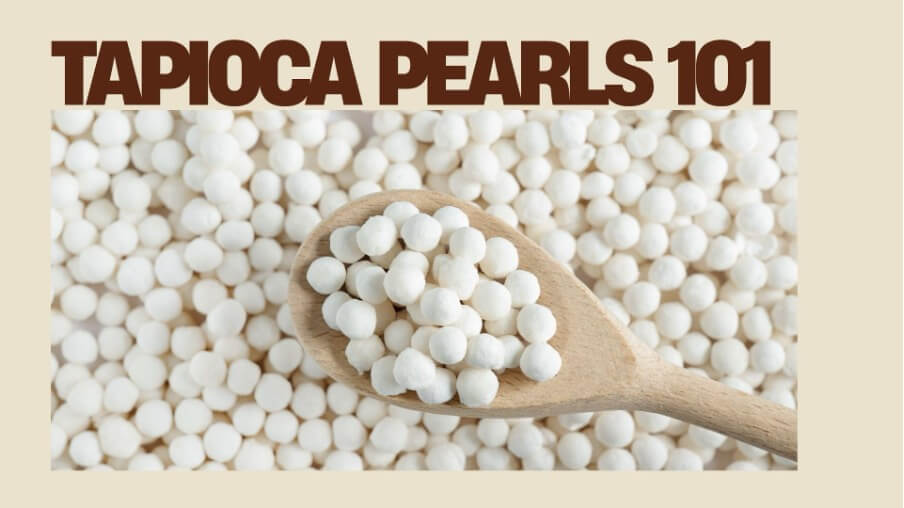
If you have read our guide to bubble tea ingredients, you already know that tapioca pearls are the single most defining element of the drink. But once you start sourcing them, it becomes clear quickly that "tapioca pearls" is not one product — it is an entire category, with meaningful differences in type, size, color, texture, and preparation format that affect everything from menu design to kitchen workflow.
This guide breaks down what those differences are, what drives them, and how to make the right choice for your operation.
Before comparing types, it helps to understand what tapioca pearls actually are at the ingredient level. The base material is cassava starch — extracted from the cassava root, mixed with water, shaped into spheres, and then either dried or pre-cooked depending on the product format.
The cassava starch content and the quality of the raw material directly determine the pearl's cooking behavior and texture. Higher-quality starch produces pearls that cook evenly, hold their shape after preparation, and maintain the right chew level for longer — which matters significantly in high-volume service environments.
Color is not purely cosmetic in tapioca pearls — it usually reflects the flavoring or sweetener used in production, which affects the pearl's taste and aromatic character.
Black / Dark Brown Pearls are the most widely recognized variety. The dark color comes from brown sugar or caramel added during production. These pearls carry a mild, slightly sweet flavor that pairs well with both milk tea and fruit tea bases. Brown sugar pearls, in particular, have become closely associated with the "tiger sugar" style drink — layered milk tea with caramel-coated pearls and visible syrup striping on the cup wall.
Amber Pearls are a lighter variation, made with a smaller proportion of brown sugar. The result is a subtler sweetness and a translucent, golden-brown appearance. They work well in drinks where the pearl's visual appeal is part of the presentation.
White / White Jade Pearls are made without added colorant, resulting in a pale, near-translucent appearance. Their flavor is neutral, making them a versatile choice for fruit teas, lighter milk teas, and specialty drinks where the pearl should not compete with other flavor notes.
Honey Pearls are sweetened with honey rather than brown sugar, producing a softer flavor profile and a slightly lighter color. They are a popular option for shops aiming to differentiate their topping selection with a more natural or artisan positioning.
Colorful / Rainbow Pearls — available in colors such as green, pink, and blue — are made using food-grade colorants and are designed primarily for visual impact. They are widely used in children's drinks, seasonal promotions, and any menu where presentation is a key selling point.
The preparation format determines how pearls are handled in a commercial kitchen and has practical implications for storage, workflow, and logistics.
Dry Pearls (Traditional Format) — Dry pearls are the original commercial format. They are sold in their uncooked state and must be boiled before service — typically for 20 to 30 minutes, depending on pearl size, followed by a soaking period in sugar syrup. The preparation process requires planning and timing, but dry pearls offer the longest shelf life, the most cost-effective storage, and the widest flexibility for customizing cook level and sweetness.
Frozen Instant Pearls — Pre-cooked and then frozen immediately after production, frozen instant pearls are designed to reduce kitchen prep time significantly. To serve, they are thawed — either overnight in refrigeration or quickly under warm water — and are ready within minutes. This format suits shops with high turnover and limited prep capacity. The trade-off is that they require cold storage and a reliable cold chain from supplier to kitchen.
Room Temperature Instant Pearls — Room temperature instant pearls are shelf-stable at ambient temperature, requiring no freezing or refrigeration at any point in the supply chain. They are produced through a preservation process that maintains texture without cold storage. This format has grown considerably in demand among international buyers, particularly those operating in regions where maintaining a consistent cold chain is operationally difficult or costly.
With the available options understood, the decision comes down to four practical questions.
One quality dimension that does not appear in standard supplier catalogs but affects real-world performance significantly is microbial stability. Tapioca pearls have high moisture and nutrient content — conditions that accelerate microbial growth when raw material quality is inconsistent or testing is inadequate. The practical consequence shows up in the kitchen: pearls that behave inconsistently during cooking, lose texture faster than expected after preparation, or produce off-flavors in the finished drink are typically the result of raw material variability that was not caught upstream.
When evaluating pearl suppliers, it is worth asking whether they test incoming raw materials independently rather than relying solely on supplier certificates, and whether they conduct per-batch testing rather than periodic sampling. These questions are more revealing than certification paperwork alone.
The importance of matching pearl formulation to operating environment is not theoretical. A bubble tea chain in Mexico discovered this after testing tapioca pearls from multiple suppliers without resolving a consistent problem: pearls that appeared cooked on the outside but remained hard at the center. The root cause turned out to be altitude — at elevation, water boils below the temperature needed for standard pearl formulations to cook through fully. The problem was solved not by finding a better-quality standard pearl, but by developing a formulation adapted to the specific thermal environment of the client's kitchens. For operators sourcing pearls for unusual climates, high altitudes, or non-standard equipment, this kind of technical collaboration is worth factoring into supplier selection.
BubblePhil supplies tapioca pearls across the full range of types and preparation formats — including Brown Sugar, Amber, White Jade, Honey, and Colorful varieties in multiple color options. Products are available in standard commercial pack sizes of 3 kg × 6 bags or 1 kg × 20 bags per case.
BubblePhil's tapioca pearls are manufactured by T Foods Co., Ltd. under FSSC 22000, ISO 22000, HACCP, and HALAL certification. All certifications are maintained through annual renewal and independent third-party audit. Each production batch undergoes in-house laboratory testing — covering microbial counts, moisture content, allergen screening, and dimensional specifications — before shipment.
For buyers looking to source a single pearl variety or build out a full topping selection, BubblePhil's range covers the core commercial requirements without the need for multiple supplier relationships. Browse the full tapioca pearl range or contact us to discuss your specific requirements.
Here are answers to the questions buyers and shop owners ask most often when sourcing tapioca pearls for the first time.
BubblePhil supplies commercial-grade tapioca pearls in multiple types, colors, and preparation formats to bubble tea shops, distributors, and beverage brands worldwide. Browse our tapioca pearl range or contact us to discuss your order requirements.