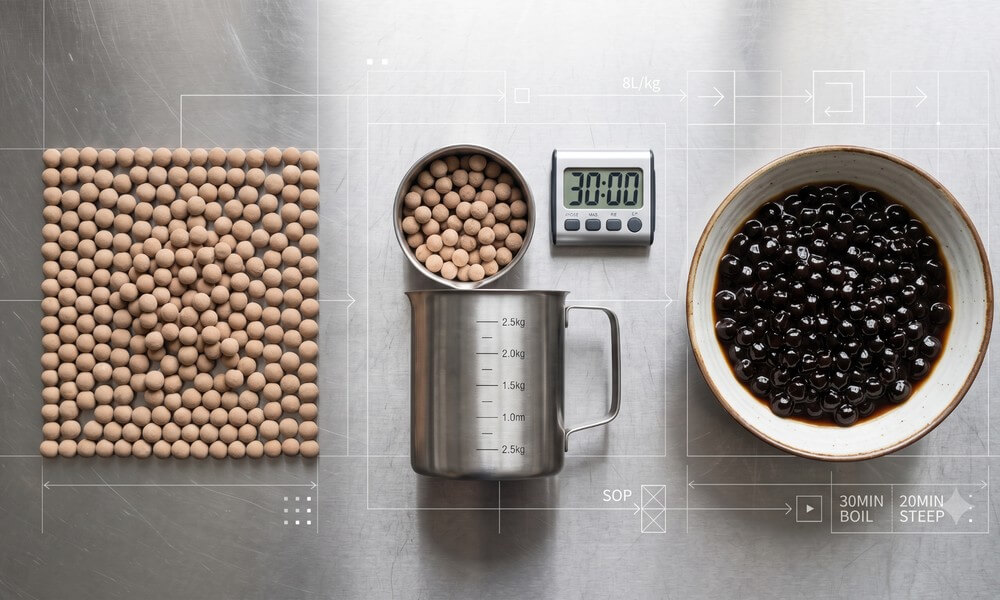
Cooking tapioca pearls commercially runs on four fixed variables: at least 8 liters of water per kilogram of dry pearls, boiling and steeping times set by pearl specification, a 10–20 minute sugar-syrup soak, and a four-hour holding limit. The times are not one number — they change with pearl size, which is why a supplier's spec sheet matters more than any general recipe.
Each of the points below decides whether a batch holds its texture through a full service period or fails halfway:
If you buy tapioca pearls for a chain, a distribution business, or a growing beverage brand, cooking is a procurement issue rather than a barista detail. Across more than 30 years supplying pearls to operators worldwide, most of the "product quality" complaints we investigate trace back not to the pearl but to how it was cooked, sweetened, and held in the store. A buyer who understands the process can tell a product problem from a process problem, and can set the requirements that protect brand consistency before the first shipment lands.
Commercial tapioca pearl cooking is a standardized batch preparation process for foodservice: a controlled water-to-pearl ratio, timed boiling and steeping, a syrup finish, and time-based holding rules. It differs from home cooking not in technical difficulty but in purpose: every cup drawn from the same batch should have the same texture, sweetness, and safety margin, from the first to the last.
The practical weight of that definition is that it turns cooking from a skill into a procedure. A skill lives with the person who has it; a procedure can be written down, trained, and audited. Consistency across locations is built on that shift.
Not every topping has to run through this process. Popping boba is made by spherification and is ready to serve straight from the tub — no pot to boil, no timed steeping, and no four-hour discard clock — which is why it is often used to extend a menu without adding bar labor. The water ratios, timing tables, and syrup rules that follow apply only to starch-based pearls that need to gelatinize.
A home cook makes one small batch and serves it immediately; a commercial operator cooks ahead of demand and serves each batch over several hours. Three things change as a result.
Scale changes the physics. Larger batches heat more slowly, lose more starch into the water, and take longer to return to a boil after pearls are added.
Time becomes the main quality variable. The starch that gelatinized during cooking gradually recrystallizes, a process called retrogradation, which is why pearls harden at the edges and lose their chew. Commercial cooking is the management of that clock.
Food safety rules apply. Cooked pearls are a time/temperature control for safety (TCS) food, which is why professional operations run a fixed discard cycle rather than serving "until they look bad."
The implication is direct: the pearl approved at head office is not the pearl the customer tastes. Between the two sits a store-level process, and sourcing decisions (format, spec sheet quality, training support) determine how well that process survives a busy shift.
The commercial baseline is at least 8 liters of water per kilogram of dry pearls, an 8:1 ratio by weight, with 10:1 recommended for large batches. Pearls release starch as they cook. In too little water that starch thickens the liquid, circulation stops, pearls stick to each other and to the pot base, and the surface cooks into a gummy film. Generous water keeps the starch dilute, keeps the pearls moving, and lets them expand to their proper size.
Yes. Very hard water, high in calcium and magnesium ions, leaves pearls firmer and dulls their gloss; heavily chlorinated water carries taste into a product that is meant to be neutral. Filtered municipal water is sufficient. What matters more is that every store in a chain uses the same water treatment, because water is one of the hidden reasons the same pearl tastes different across locations.
The most common commercial mistake is adding pearls to water that is hot but not boiling. Pearls must enter a full rolling boil so the outer layer gelatinizes immediately and seals the pearl. In warm water the surface starch dissolves instead, and the batch ends as a sticky mass. Add pearls gradually and stir gently until they all float to the surface. Flotation is the signal that the batch is fully in and circulating.
Boiling and steeping times are not a single range. They scale with pearl specification, and using one number across every product is where most in-store inconsistency begins.
| Specification | Boiling time | Steeping time |
|---|---|---|
| 2.5 | 30 minutes | 35 minutes |
| 2.3 | 30 minutes | 30 minutes |
| 2.2 | 20 minutes | 25 minutes |
| 2.0 | 15 minutes | 20 minutes |
| 1.5 | 5 minutes | 10 minutes |
Source: T Foods official cooking direction chart.
Larger pearls need proportionally more of both. Doubling the specification does not double the time, because heat has to travel to the core, and the steeping stage is what completes that transfer without overcooking the surface. Operators running more than one pearl size should treat each as a separate SOP rather than averaging the times.
The nine steps below apply to both stovetop and electric cooker. The equipment changes one judgment call: in an open pot you can watch every pearl rise to the surface, while in a covered cooker you cannot, so stir thoroughly rather than timing by flotation.
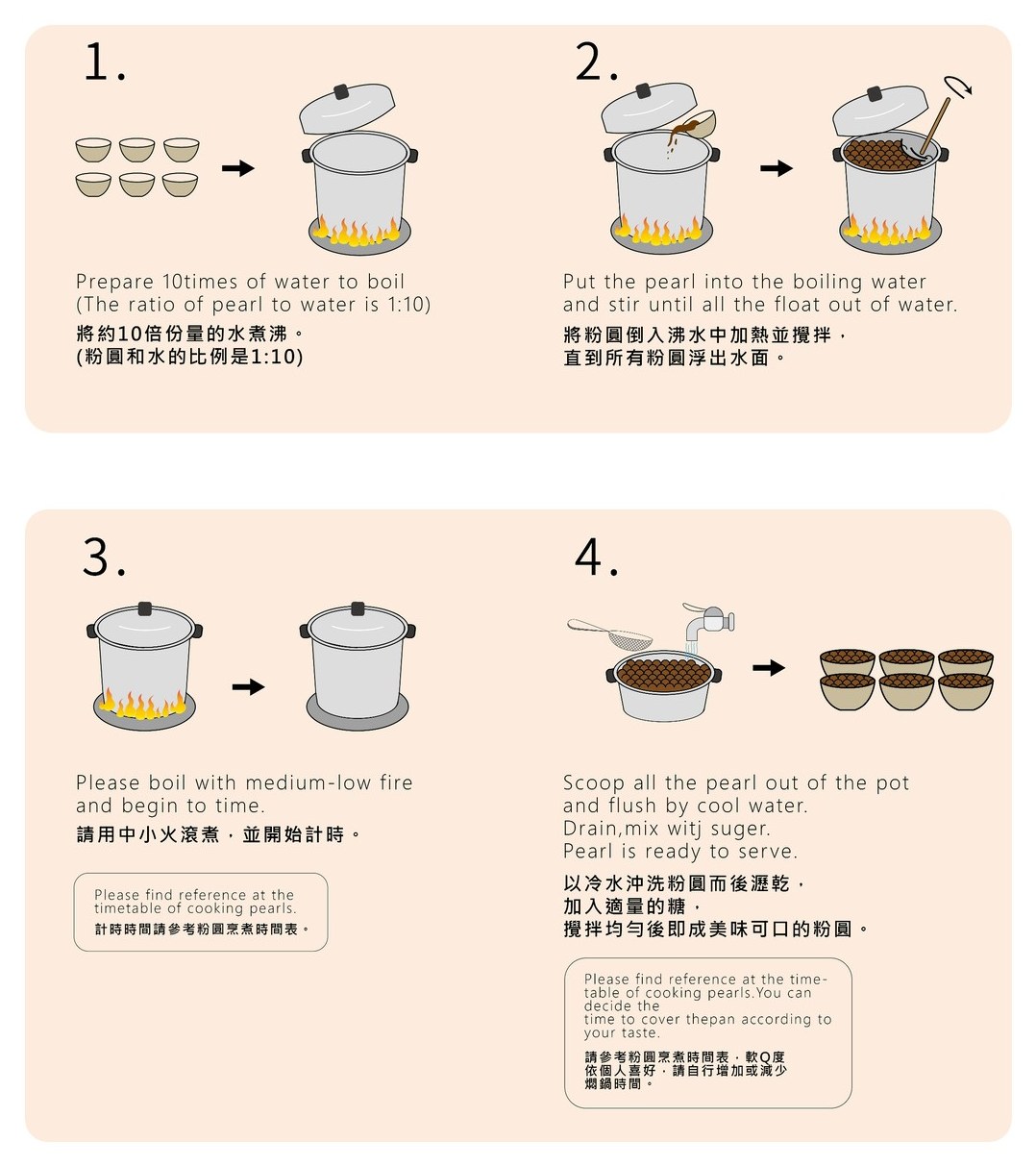
(The stovetop sequence on BubblePhil's cooking direction card: water at a rolling boil before pearls go in, pearls added until they all float, then timed to the specification chart.)
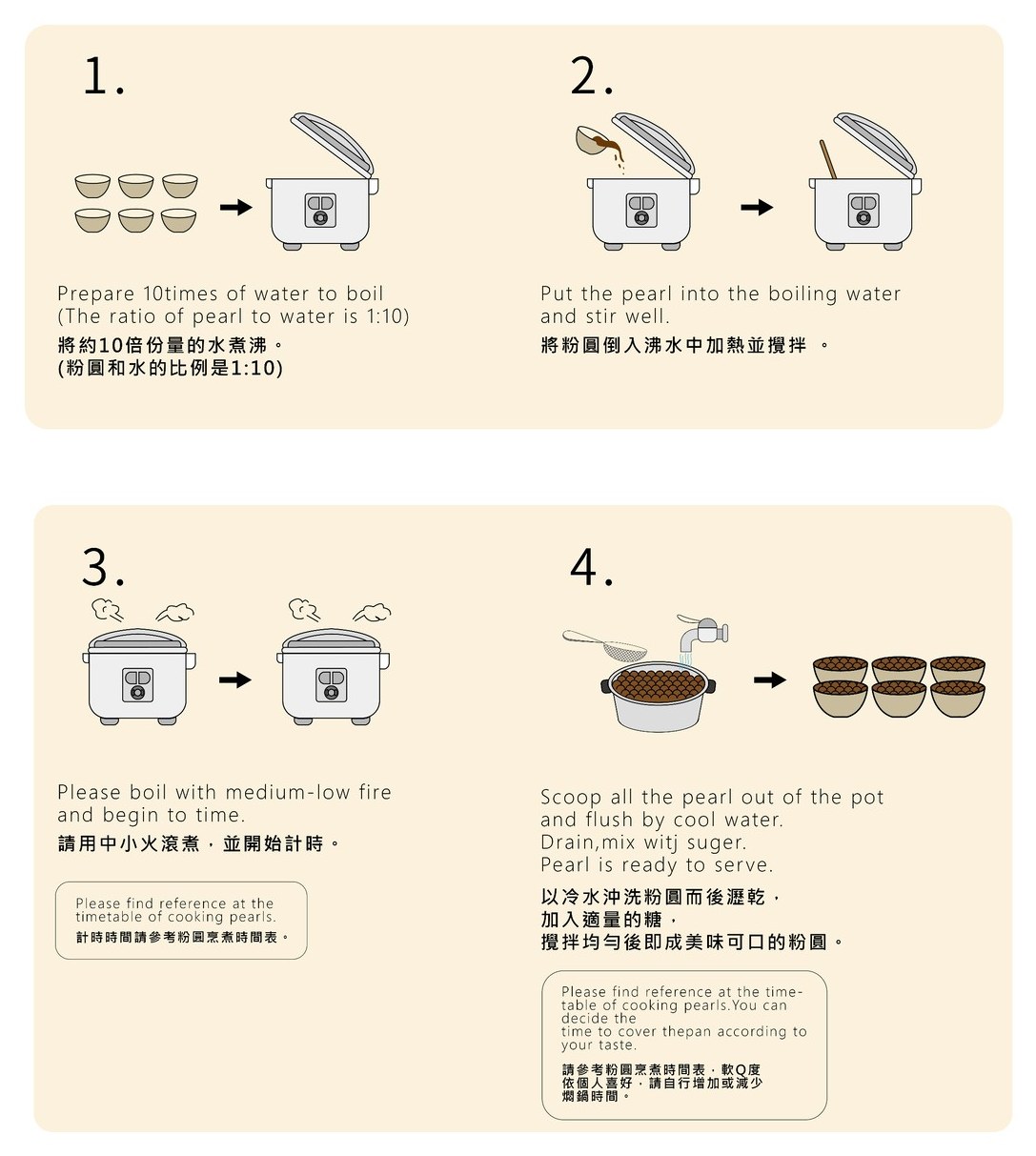
(The same sequence in an electric cooker. The card's only wording change is at the second step, where thorough stirring replaces watching the pearls float.)
High heat in, a circular stir to keep them off the base, lid on to force the boil back. Those first two minutes decide most of the batch.
Standard commercial pearls are formed at 8 mm and expand to roughly 9.5–10 mm once cooked. Frozen and shelf-stable formats follow the same logic on shorter timings, and frozen pearls go into the boil straight from the freezer, unthawed. In every case the product's own spec sheet is the final authority. That is also why buyers comparing quotes should compare cooking specifications alongside price. Two pearls at the same cost per kilogram can carry very different labor minutes, energy use, and failure rates in the store.
After rinsing, pearls go into a syrup soak for roughly 10 to 20 minutes before service. The step is doing three jobs, not one.
Standard practice is a brown sugar or simple syrup at a fixed Brix level, written into the SOP, measured with a refractometer, and identical at every location. A pearl soaked in ad-hoc "some sugar and water" is a different product at every store.
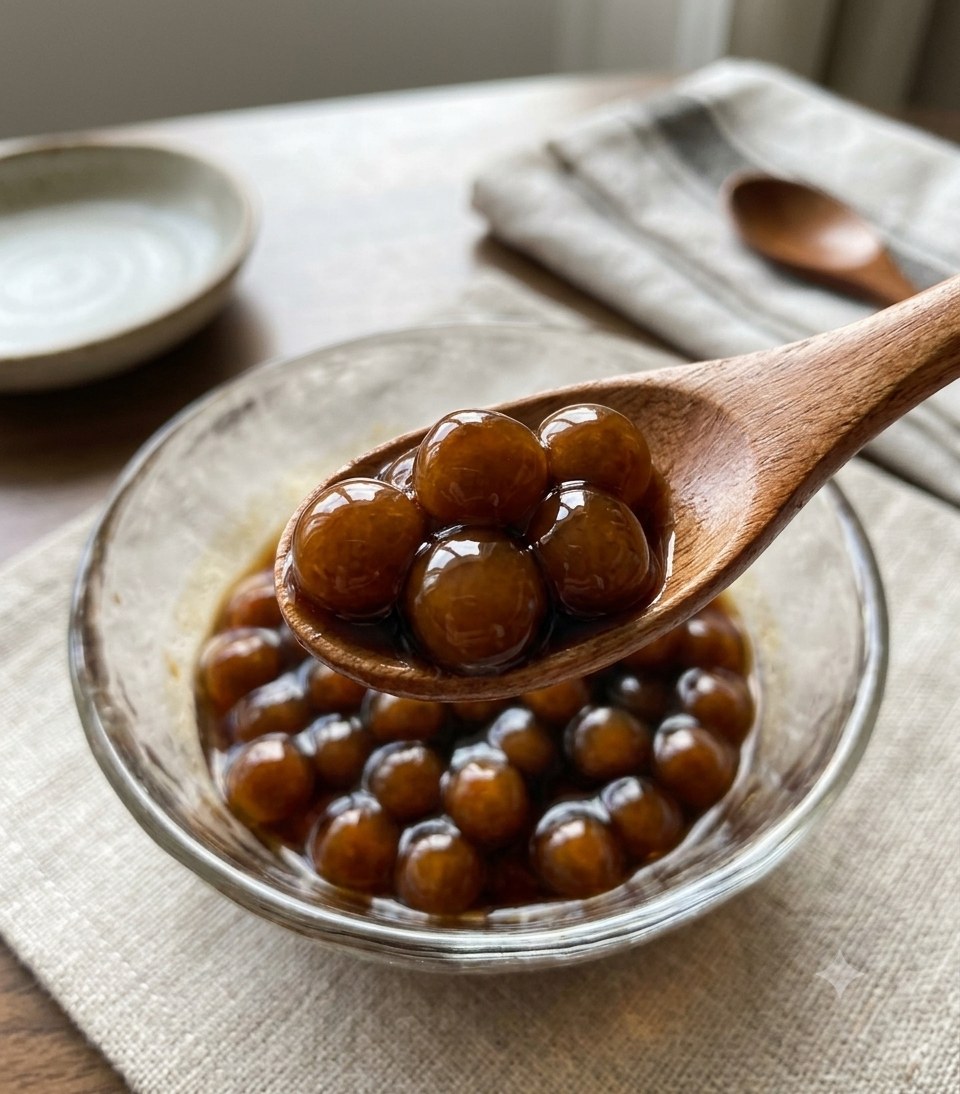
Cooked tapioca pearls held at room temperature should be served or discarded within four hours. That limit follows time-as-a-public-health-control practice for TCS foods, and it matches the texture reality: by the four-hour mark, even well-syruped pearls are visibly losing chew.
Strong operators follow five holding rules:
Refrigeration does not extend the life of cooked pearls; it shortens it. Cold storage is precisely the condition under which starch retrogrades fastest, and chilled pearls turn hard and chalky within hours. Cook to sell; discard the rest.
| Parameter | Home cooking | Commercial operation |
|---|---|---|
| Batch size | 100–300 g | 1–5 kg per cook |
| Water ratio | Plenty of water | 8:1 minimum, 10:1 for large batches, documented |
| Timing | By taste and feel | Timed boil and steep per specification chart |
| Sweetening | Optional, to taste | Syrup soak at fixed Brix, 10–20 minutes |
| Holding | Served immediately | Held in syrup; four-hour discard rule |
| Quality check | One person's palate | Doneness sampling plus batch log |
| Consistency goal | One good batch | Identical pearls across stores and shifts |
Troubleshooting quality complaints across our export markets, the same five failures account for most of them:
All five are prevented by the same tool: a one-page SOP carrying ratio, times by specification, Brix, and discard rules, trained into every shift.
If cooking process drives most in-store quality variation, a buyer's leverage sits in what they require before signing. Four conditions separate a supply partner from a commodity vendor:
These cost nothing to ask in a request for quotation (RFQ), and the answers reveal how a supplier thinks about your stores. For the wider qualification sequence around them, see our guide to choosing a tapioca pearl supplier.
Q : What is the correct water-to-pearl ratio for commercial cooking? At least 8 liters of water per kilogram of dry pearls, an 8:1 ratio by weight, with 10:1 for large batches. Pearls leach starch as they cook, and in too little water that starch thickens the liquid, stops circulation, and produces clumping and a gummy surface.
Q : Why must tapioca pearls go into boiling water, not warm water? A full rolling boil gelatinizes the outer starch layer on contact and seals the pearl. In warm water that layer dissolves into the pot instead, and the batch fuses into a sticky mass.
Q : How long do you boil and steep tapioca pearls commercially? It depends on pearl specification. BubblePhil's official chart runs from 5 minutes boiling plus 10 minutes steeping for 1.5 specification pearls, up to 30 minutes boiling plus 35 minutes steeping for 2.5 specification. Always cook to the chart for the product you bought rather than to a general range.
Q : What does the covered steeping stage actually do? Steeping holds the pearls in hot water off high heat, letting heat travel to the core while the surface stops cooking. Skipping it is the standard cause of pearls that look translucent outside but keep a hard center.
Q : When does the cooking timer start? Once the water has returned to a full boil after the pearls go in, not at the moment they enter the pot. Large batches drop the water temperature noticeably, and timing from the moment of entry undercooks the batch.
Q : How long should cooked pearls soak in sugar syrup? Roughly 10 to 20 minutes before service, in syrup at a fixed Brix level. Beyond flavor, the syrup slows moisture loss and delays the hardening that follows cooking.
Q : How long can cooked tapioca pearls be held before serving? Four hours at room temperature, held in syrup and covered. Both food safety practice for TCS foods and texture point to the same limit.
Q : Can you refrigerate cooked tapioca pearls and reuse them later? No. Refrigeration accelerates starch retrogradation, and chilled pearls turn hard and chalky within hours. Cooked pearls are made to sell the same day.
Q : Why do pearls from the same supplier taste different across locations? Usually water treatment, boil recovery time, or an unmeasured syrup. Stores that filter differently, run under-ratio water, or sweeten by eye produce measurably different pearls from identical cartons. That is why a written SOP and a fixed Brix target matter more than staff experience.
Knowing how to cook tapioca pearls commercially gives a buyer a framework for judging where quality is decided. Half of it lives in the store: full boil, correct water ratio, timed steep by specification, measured syrup, four-hour clock. The other half lives in the supply chain, in a pearl manufactured consistently enough that the same SOP produces the same result from one carton to the next.
A store SOP can correct a process problem. It cannot correct a pearl that cooks differently every delivery.
BubblePhil is the international brand of T Foods Co., Ltd., a tapioca pearl manufacturer in Taoyuan, Taiwan with over 30 years in the category. Every product ships with the cooking direction chart reproduced above, covering ratio, boiling and steeping times by specification, and holding guidance, in the formats the buyer actually ordered.
T Foods holds four internationally recognized certifications: FSSC 22000, ISO 22000, HACCP, and HALAL, each maintained through annual renewal and independent third-party audit, with regular verification through SGS. Every batch is tested at three stages (incoming raw materials, in-process semi-finished goods, and finished product before shipment), as set out on our quality management page. For how those controls apply during production itself, see how tapioca pearls are made.
Batch testing confirms the pearls leave the factory identical. A cooking chart your staff can actually follow is what confirms they arrive that way in the cup.
Evaluating pearl suppliers for a chain, a distribution business, or a new market? Contact the BubblePhil team for product specifications, cooking charts by format, and samples.