Eight production steps stand between a cassava root and a tapioca pearl that holds its "QQ" texture for four to six hours after cooking. Most quality problems — inconsistent chew, hard centers, shelf life shorter than spec — trace back to stages in the manufacturing process that most buyers never evaluate when selecting a supplier. Buyers who know where to look are better positioned to ask the right questions, and to tell the difference between a vendor and a partner. This article walks through each step, where quality control applies, and why raw material handling determines more than most buyers expect.
Tapioca pearls are made from cassava starch, not rice starch, not potato starch. The distinction matters, because the specific molecular structure of cassava starch is what produces the "QQ" chew that defines the product.
Cassava starch has an unusually high proportion of amylopectin. When heated, amylopectin forms an elastic, stretchable gel, the structural property that no other commercially viable starch replicates at the same scale. That gel is the pearl's chew. Strip it out and you have a different product.
Cassava grows primarily in Thailand, Vietnam, and other Southeast Asian countries, where warm climate and year-round growing seasons support consistent supply at commercial volume.
Cassava is harvested 8 to 12 months after planting. Once cut, the roots begin degrading, starch quality drops with time, which is why speed from field to processing facility is a logistics requirement, not a preference.
At the facility, roots are dry-screened then paddle-washed to remove soil, grit, and surface contaminants before any cutting or grinding occurs. Processing on unclean material introduces contamination that cannot be fully removed downstream.
What happens in Steps 2 and 3 is only as good as what enters them.
Cassava skin contains cyanogenic glycosides, compounds that must be eliminated before the starch is suitable for food use. Peeling removes the primary concentration; subsequent processing steps reduce residual levels to food-safety compliance.
Peeled roots are then fed into high-speed grinding equipment, reducing them to a fine slurry. Particle size at this stage affects extraction efficiency in Step 3, coarser grinding leaves extractable starch locked in fiber.
The cassava slurry leaving the grinder contains starch, fiber, protein, cell fluid, and water. These components need to be separated before a food-grade starch can be produced. The separation sequence runs in three stages:
Starch purity at this stage sets the ceiling on everything that follows.
Purified tapioca starch is dewatered and then dried under controlled temperature to reduce moisture content. Food-grade tapioca starch is typically held below 14% moisture, a threshold that supports processing stability and safe storage.
Microbial stability deserves specific attention here. Tapioca pearls have high moisture and nutrient content, which creates conditions for rapid microbial growth when raw material quality is inconsistent. The important distinction, confirmed by BubblePhil's quality management team: microbial non-conformances affect shelf life , not taste or texture. A pearl can be microbially out of specification and still pass a standard cook-and-taste evaluation at the shop level.
That gap, between what a taste test catches and what a lab test catches, is why independent incoming material testing exists. Certification paperwork does not close it. Batch-level testing does.
High-quality tapioca starch is blended with water, along with modified starch, coloring, and other food ingredients as required by each product specification, then mixed and kneaded into a smooth, workable dough.
The key physical transformation at this stage happens within the starch itself: as the granules absorb water and swell, they undergo partial gelatinization, forming a viscous gel matrix that binds the loose powder into a cohesive, pliable dough. This gel network gives the dough the structural strength and elasticity needed for shaping — and ultimately forms the structural backbone of the finished pearl.
Industrial production uses automated mixing equipment to control recipe ratio, temperature, and mixing speed. The formulation, however, does not behave identically in every kitchen. Water mineral content and altitude both alter how gelatinization proceeds — at elevation, water boils below the temperature a standard formulation requires for full cook-through. No adjustment to cooking time at the shop level compensates for a formulation not calibrated to that environment.
This is the distinction between a supplier that ships a catalog product and one that develops a formulation matched to the client's operating conditions. The manufacturing step looks identical from the outside. The performance gap at altitude or in hard-water markets is not identical, and it shows up in the cup.
Color is determined at Step 5, during recipe mixing, which means it is a direct read-out of what went into the dough. A supplier who cannot explain why a pearl is a particular color is a supplier who cannot fully account for their own recipe.
Color in tapioca pearls is not cosmetic, it reflects what is in the recipe. Black and dark brown pearls get their color from brown sugar or caramel added during mixing; the same ingredient that creates the color also contributes a mild sweetness and aromatic character. Colored pearls using natural plant powders (matcha, purple sweet potato, butterfly pea flower) carry a corresponding flavor note. Artificially colored pearls use food-grade colorants — buyers sourcing for regulated markets should confirm the colorants are compliant with the applicable import standards.
Common types available commercially:
For a full comparison of pearl types by color, preparation format, and sourcing format, see our tapioca pearl selection guide. For a broader overview of how tapioca pearls fit into the complete bubble tea ingredient lineup, including syrups, creamer, and specialty toppings, the full ingredient guide covers each component in detail.
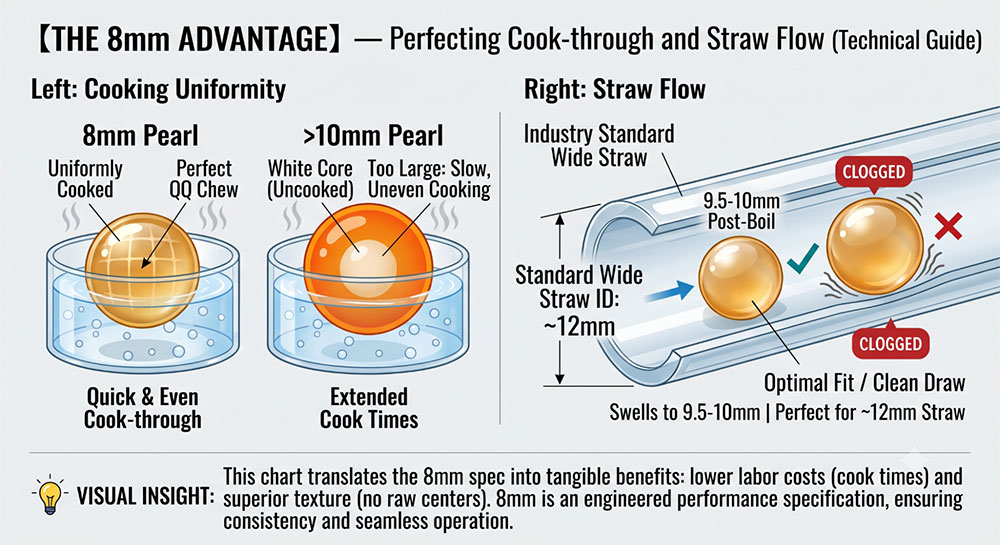
Once the dough is ready, it is fed into automated forming equipment that granulates and rounds it into uniform spheres. Consistency of size at this stage is what ensures even heat distribution during cooking — pearls that vary in diameter cook at different rates, producing a mix of overdone and underdone in the same batch.
Standard commercial tapioca pearls measure approximately 8mm in dry diameter. This is not an arbitrary convention — it is a performance specification built around two functional requirements. At 8mm, pearls reach full cook-through faster than larger boba formats, reducing prep time in high-turnover shop environments without sacrificing the chew level that defines the eating experience. The 8mm dry diameter also swells to approximately 9.5mm–10mm after cooking, which aligns with the physical limits of standard 12mm bubble tea straws — large enough to pass freely, without risk of clogging. Mini pearls (around 5mm) are used in blended and slush-format drinks where a smaller bite is preferred.
After forming, pearls enter a temperature- and humidity-controlled drying system that reduces water activity. Lower water activity slows microbial growth and extends shelf life under transport and storage conditions.
Three product formats leave this stage, each with different shelf-life profiles and prep requirements:
Format selection depends on kitchen workflow, storage infrastructure, and cold chain availability across the buyer's distribution network. Our guide to choosing the right pearl format covers the practical trade-offs in detail.
Tapioca pearls must be cooked before serving. The standard process:
Optimal cooking time varies by product format and specification. Follow the method the manufacturer provides — not a generalized guideline.
When pearls cook unevenly—exhibiting a mushy exterior with a hard center, or degrading faster than specification—starting the investigation with the shop's cooking SOP is standard and necessary, as individual operational deviations account for most isolated consistency issues. That is the right starting point. But it is not always the final answer.
However, when standard operating procedures have been strictly verified across multiple locations and quality issues persist, the diagnostic focus must shift upstream. These systemic, regional failures are typically rooted in a formulation that hasn't been calibrated to local water hardness or altitude (Step 5), or raw starch purity levels that failed to block subtle organic impurities during processing (Steps 3 and 4).
Cooked pearls hold optimal texture for 4 to 6 hours. After that window, texture degrades regardless of original quality. High-volume operations should calibrate batch sizes to expected service demand rather than cooking in advance.
The table below maps color type to ingredient base, flavor profile, and common application — a reference for buyers building out a topping selection or evaluating SKU breadth:
| Type | Ingredient base | Flavor / character | Paired best with |
|---|---|---|---|
| Classic black | Tapioca starch + brown sugar | Mild sweetness, caramel aroma | Milk tea, brown sugar fresh milk |
| Amber | Tapioca starch + caramel syrup | Lighter sweetness, translucent | Seasonal and specialty menus |
| White / clear | Tapioca starch only | Neutral — adds no flavor | Fruit tea, lighter bases |
| Colored | Tapioca starch + natural plant powder or food-grade colorant | Flavor follows color source — matcha, taro, or fruit powder | Seasonal / promotional menus |
Popping boba are not tapioca pearls — they are produced through sodium alginate spherification, a process with no overlap with starch gelatinization. The two products serve different sensory roles and require separate sourcing decisions. See our comparison guide [Popping Boba vs. Tapioca Pearls] for the full breakdown.
A well-made tapioca pearl meets these criteria at point of service:
Those criteria are the outcome. The inputs that determine them are not visible at the shop level:
For buyers, this means that evaluating a tapioca pearl supplier based on a product sample tells you whether the current batch is good. It does not tell you whether the next batch will be the same.
The questions below come up regularly from buyers sourcing tapioca pearls for the first time — covering ingredients, sizing, shelf life, and customization options.
Yes. Tapioca starch contains no wheat, barley, or rye. Tapioca pearls are naturally gluten-free. If a product is manufactured on shared lines with gluten-containing ingredients, the product label will state this.
Generally yes — tapioca pearls are made primarily from plant-based ingredients (tapioca starch, water, sugar). Confirm with the specific product's ingredient list and labeling before making claims to end consumers.
Approximately 8mm in diameter. At 8mm, pearls reach full cook-through faster than larger boba formats — reducing kitchen prep time in high-turnover service environments — without giving up the chew level that defines the eating experience. Mini pearls run around 5mm and are used in blended or slush-format drinks.
4 to 6 hours after cooking, held in syrup at room temperature. After that window, texture degrades regardless of initial quality. High-volume operations should cook in batches calibrated to service demand.
Cassava starch has a high proportion of amylopectin, which forms an elastic gel structure when heated. That gel is the "QQ" chew. No other commercially viable natural starch produces the same combination of elasticity and gel strength at production scale.
Yes. Manufacturers with R&D capability can adjust pearl size, base sweetener, formulation, and flavor profile for buyers developing branded recipes or sourcing for non-standard operating conditions (altitude, water hardness, local regulatory requirements). Lead times and minimum order quantities vary by scope.
Tapioca pearls are solid, uniformly chewy spheres made from cassava starch gelatinization. Popping boba are thin-skinned gel spheres made through sodium alginate spherification, containing a liquid juice center that bursts when bitten. Different production processes, different ingredients, different sensory roles on a menu.
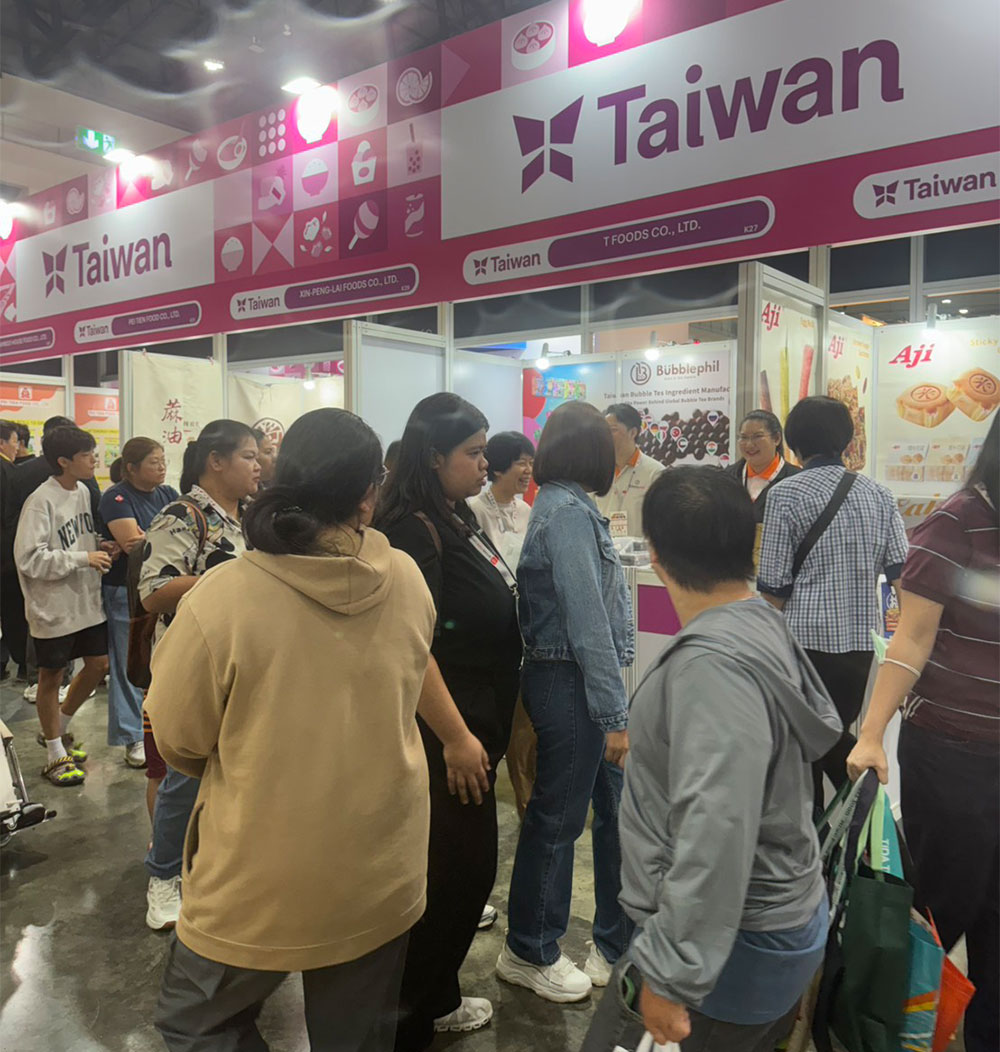
BubblePhil is the international brand of T Foods Co., Ltd., a tapioca pearl manufacturer based in Taoyuan, Taiwan, with more than 30 years of experience in the bubble tea ingredient category. Every pearl BubblePhil supplies is manufactured at T Foods' facility under four internationally recognized certifications: FSSC 22000, ISO 22000, HACCP, and HALAL, each maintained through annual renewal and independent third-party audit.
T Foods' in-house laboratory tests at three stages of every production run:
Third-party verification is conducted regularly through SGS. The laboratory is independently audited on an annual basis to maintain accreditation.
The product range covers tapioca pearls across all formats and colors, brown sugar, amber, white jade, honey, and colored varieties in standard commercial pack sizes (3 kg × 6 bags or 1 kg × 20 bags per case). OEM/ODM formulation services are available for buyers developing branded recipes or sourcing for non-standard operating environments.
The certifications confirm the system works. Three decades of clients reordering is what confirms the pearls do too.
If you are evaluating tapioca pearl suppliers, comparing formats, or building out an OEM specification, the most direct next step is a conversation with our sourcing team — or a look at the full product range first.
Browse the BubblePhil tapioca pearl range | Contact us to request samples or discuss your sourcing requirements