Walk into any bubble tea shop and the menu likely offers both tapioca pearls and popping boba. To a first-time buyer, they can look deceptively similar — small spheres sitting in a jar or container, ready to drop into a drink. In practice, they are entirely different products: different ingredients, different textures, different production methods, and different roles on a menu.
If you are building a bubble tea menu or evaluating toppings to source, understanding the distinction clearly will save you from ordering the wrong product — and help you use each one where it actually performs best.
Before getting into the differences, it is worth noting what the two share. Both are sphere-shaped toppings used in bubble tea and other cold beverages. Both are available in a range of colors and flavors. Both are designed to be consumed through a wide straw alongside the drink. And both are sourced commercially in bulk from ingredient manufacturers.
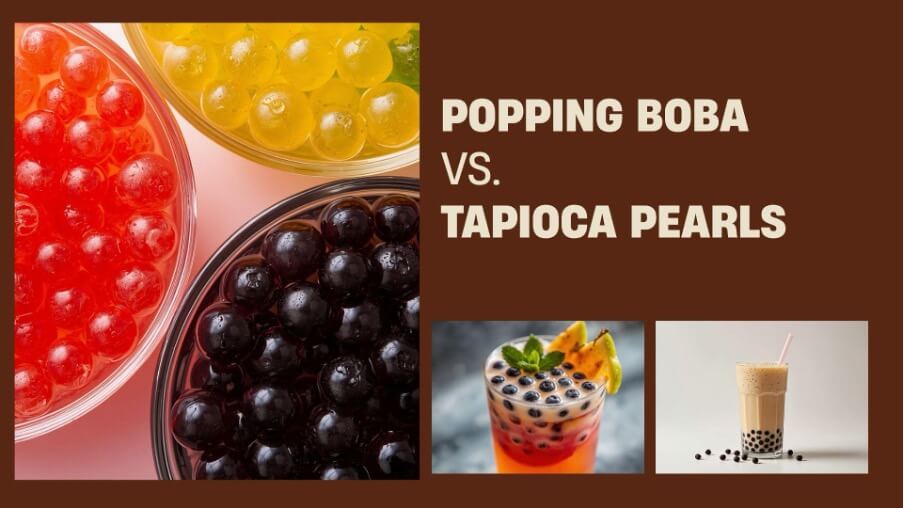
As covered in our guide to tapioca pearls, tapioca pearls are made from cassava starch — shaped into solid spheres, cooked until soft, and soaked in sugar syrup before serving. The result is a uniformly chewy, dense bite with no liquid center. The texture is the point: the satisfying resistance of a well-cooked pearl is central to the bubble tea drinking experience.
Tapioca pearls carry flavor primarily from brown sugar, honey, or plain sugar — and from the syrup they are soaked in after cooking. They do not burst. They do not release juice. They are eaten as a textural element, not a flavor delivery mechanism.
Standard commercial pearls measure approximately 8mm in diameter. They require cooking before service — either from dry (boiling from raw), or from pre-cooked frozen or room temperature instant formats that eliminate the prep time. Their optimal serving window after cooking is typically 4 to 6 hours, after which texture degrades.
Popping boba are gel spheres produced through a process called spherification — a technique that uses sodium alginate and calcium chloride to form a thin, firm gel membrane around a liquid center. The result is a sphere that holds its shape under normal handling but ruptures when bitten, releasing the juice inside.
The filling is where the flavor lives. Unlike tapioca pearls, which derive their taste from the starch base and soaking syrup, popping boba deliver a burst of concentrated fruit juice — or in some cases, a yogurt or cream filling — directly when eaten. The sensory experience is fundamentally different: less chew, more burst, and a sharp flavor release that pairs particularly well with lighter fruit-based drinks.
Popping boba require no cooking and no preparation beyond portioning. They are shelf-stable in their sealed packaging and ready to serve directly from the container, making them considerably easier to manage from a kitchen workflow standpoint.
| Tapioca Pearls | Popping Boba | |
|---|---|---|
| Base material | Cassava starch | Sodium alginate gel + juice filling |
| Texture | Solid, uniformly chewy | Thin gel skin, liquid center |
| Flavor delivery | Mild — from starch base and syrup | Concentrated — bursts on contact |
| Preparation required | Yes — cooking or thawing | No — ready to serve |
| Shelf life (after opening) | 4–6 hours post-cooking | Days, when refrigerated after opening |
| Best paired with | Milk teas, brown sugar drinks | Fruit teas, yogurt drinks, light flavors |
| Visual appeal | Classic, familiar | Colorful, novelty factor |
| Customization options | Size, color, sweetener, format | Flavor, color |
Tapioca pearls are the default choice for milk-tea-based drinks. The dense chew of a well-cooked pearl complements the richness of milk tea, brown sugar syrup, and taro. They anchor the drink's texture without competing with the flavor. For classic bubble tea formats — brown sugar milk tea, taro milk tea, matcha latte — tapioca pearls are the natural choice.
Popping boba perform best in lighter, fruit-forward drinks where the burst of juice enhances rather than fights the base. A green tea with mango popping boba, or a lychee fruit tea with lychee popping boba, creates a layered flavor experience that a tapioca pearl would not provide. They are also a strong choice for shops targeting consumers who are new to bubble tea — the novelty of the burst creates a memorable first experience.
Using both is increasingly common and commercially sound. Offering tapioca pearls as the classic option alongside two or three popping boba flavors gives customers a choice and allows a shop to serve a broader range of drink styles without significantly increasing operational complexity. Popping boba require no cooking, so adding them to the menu does not add prep time.
The two products have different sourcing dynamics worth factoring into purchasing decisions.
Tapioca pearls involve more SKU decisions upfront — format (dry, frozen, room temperature), color, and size all need to be specified. They also have a tighter operational window after cooking, which affects how quantities are planned per service period.
Popping boba are simpler to manage operationally but involve more flavor SKU variety. Stocking too many flavors creates inventory complexity; too few limits menu differentiation. A practical starting point for most shops is three to five flavors that cover a range of fruit profiles — typically a citrus, a tropical, a berry, and a lighter option such as lychee or peach.
For both products, supplier consistency is a more reliable predictor of operational outcomes than unit price. Pearls that cook unevenly — or that harden faster than expected after preparation — create service disruptions that no cost saving justifies. Popping boba with membranes that rupture prematurely in the container, or that vary noticeably in flavor intensity between batches, undermine the drink experience in ways that are difficult to diagnose without knowing where to look.
The underlying cause in both cases is usually raw material variability that was not caught upstream. Suppliers who test incoming raw materials independently — rather than relying on supplier-provided certificates — and who conduct per-batch verification throughout production provide a meaningfully more stable foundation than those who rely on periodic sampling or certification paperwork alone.
For buyers sourcing into Japan, South Korea, or the EU, supplier documentation requirements add another layer to consider. Both Japan and South Korea impose stricter microbial standards for imported food ingredients than most other markets, and some product categories are subject to preservative-free requirements. Confirming that your supplier actively monitors these requirements — and adjusts product formulations accordingly — is a practical step worth taking before committing to a supply relationship.
BubblePhil supplies both tapioca pearls and popping boba to commercial buyers worldwide. The popping boba range covers 15 fruit and specialty flavors — including Mango, Strawberry, Lychee, Passionfruit, Peach, Blueberry, Kiwi, Lemon, Pineapple, Pomegranate, Orange, Grapefruit, Cantaloupe, Green Apple, and Yogurt — giving shops and distributors enough variety to build a differentiated topping menu from a single supplier.
For buyers sourcing both pearls and popping boba together, consolidating with one supplier simplifies procurement, reduces minimum order fragmentation, and makes logistics coordination more straightforward.
BubblePhil's popping boba and tapioca pearls are manufactured by T Foods Co., Ltd. under FSSC 22000, ISO 22000, HACCP, and HALAL certification. All certifications are maintained through annual renewal and independent third-party audit. Each production batch undergoes in-house laboratory testing before shipment — including microbial verification — to ensure product stability and compliance with international food safety standards.To see our full commercial offering, browse our popping boba range or explore our tapioca pearl selection today.
Here are answers to the questions that come up most often when buyers are choosing between the two.
BubblePhil supplies popping boba in 15 flavors and tapioca pearls in multiple types and formats to bubble tea shops, distributors, and beverage brands worldwide. Browse our full product range or contact us to discuss your sourcing requirements.