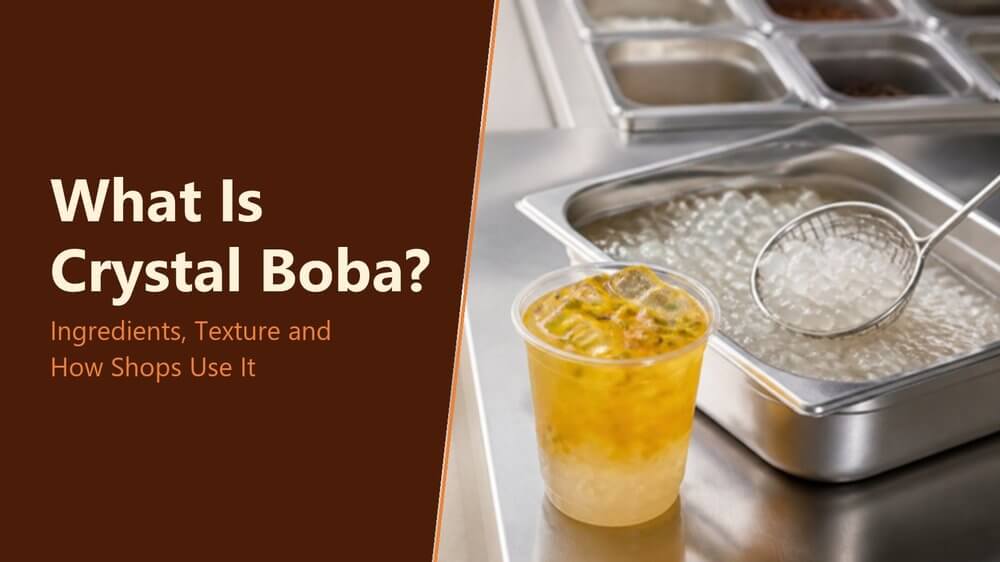
Crystal boba is a translucent, chewy bubble tea topping made from plant-based gelling agents instead of tapioca starch, and it is usually sold ready to serve in syrup. Sellers also call it agar boba or white pearls. The name suggests one ingredient, but commercial crystal boba can be built on agar, konjac, carrageenan or a blend of them, and some products sold as agar boba list no agar on the label. That difference changes the bite, how long the topping holds up after opening, and which questions a shop should put to its supplier.
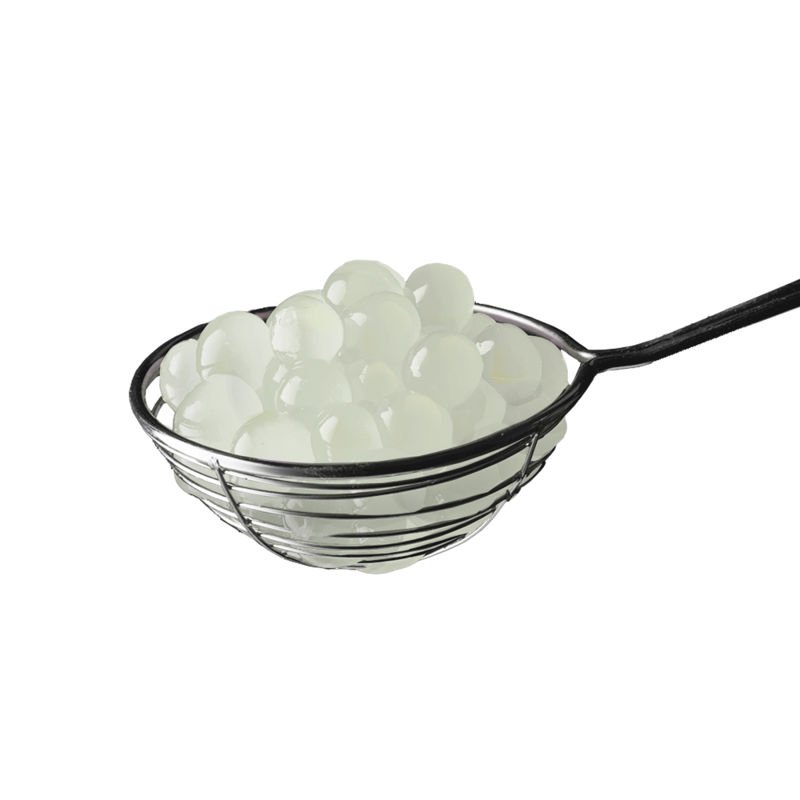
Crystal boba is a clear, springy bubble tea topping shaped into small spheres from a plant-based gel, and it has little flavor of its own. Buyers use several names for it, and the names overlap with products that are not crystal boba at all, so the table below sorts them out.
| Name you may see | What it usually means |
|---|---|
| Crystal boba | The general name for the translucent gel topping |
| Agar boba | Crystal boba sold as agar-based, which the label may or may not confirm |
| White pearls | A common retail alias for crystal boba |
| Konjac boba | Crystal boba built on konjac, a root-derived gel |
| Clear tapioca | A misnomer. Tapioca is a starch, and crystal boba contains none |
| White Jade tapioca pearls | A different product: tapioca pearls made from starch and cooked before serving |
The last two rows matter most when you place an order. A buyer who asks for "white pearls" can receive either a gel topping or a pale tapioca pearl, and the two need completely different prep. For where crystal boba sits among the other ingredients in a drink, see BubblePhil's guide, What Is Bubble Tea? A Complete Guide to Ingredients & How It's Made.
Crystal boba is made from one or more of three gelling agents: agar, konjac and carrageenan. Each sets into a different gel, and each is extracted from a different plant, which is why two products with the same name can eat very differently.
Agar is a gelling agent extracted from red seaweed, and it sets into a firm, brittle gel. Of the three gelling agents, it produces the firmest bite. Agar is the ingredient most people mean when they say "agar boba."
Konjac is a gelling agent made from the root of the konjac plant, and its main component is glucomannan, a dietary fiber rather than a starch. Many commercial crystal boba products are konjac-based, and konjac gels tend to look clear and bite crisp.
Carrageenan is a gelling agent extracted from red seaweed, and it is common on ingredient labels for commercial crystal boba even though most explainer articles never mention it. It sets into a softer, more elastic gel than agar, and manufacturers often blend it with konjac.
The name on the bag does not guarantee the gelling agent, so read the ingredient label. Some widely sold crystal boba is marketed as "agar boba" or "white pearls" while its ingredient list names carrageenan and konjac powder as the gelling agents and does not include agar. The same labels often add sweeteners and preservatives, so the label tells you more than the name does.
With the ingredients sorted out, the next question is how those differences show up in the mouth.
Crystal boba tastes mild, and nearly all of its sweetness comes from the syrup it is packed or soaked in. That makes crystal boba a carrier for a drink's flavor rather than a flavor of its own.
The texture is where descriptions disagree. Some sources call crystal boba crunchier than tapioca pearls, and others call it softer. Those descriptions are not contradictory once the gelling agent is taken into account. A konjac-heavy or agar-heavy product bites crisp, and a carrageenan blend bites softer and more elastic, so a bite description is only as reliable as the label behind it.
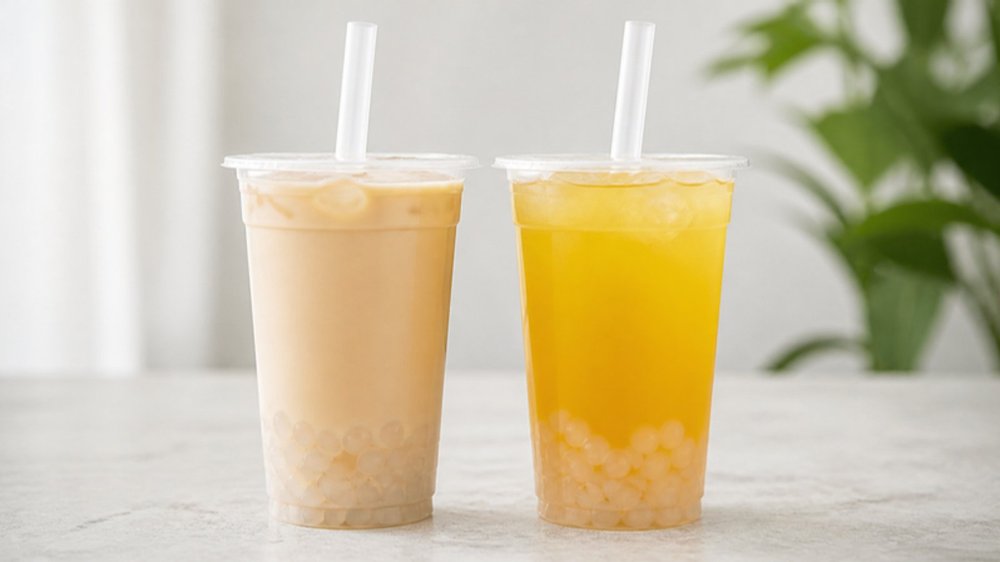
Crystal boba differs from tapioca pearls mainly in prep and from popping boba mainly in structure. The table compares the three toppings on the points a shop deals with every day.
| Tapioca pearls | Crystal boba | Popping boba | |
|---|---|---|---|
| Main component | Cooked starch | Plant-based gel (agar, konjac or carrageenan) | Thin skin around a flavored syrup center |
| Bite | Soft, chewy, sticky | Springy and translucent, firmer or softer by gelling agent | Skin bursts, syrup flows out |
| Prep | Cook in batches | Usually sold ready to serve | Ready to serve |
| Time in the cup | Serve or discard cooked tapioca pearls within 4 hours | Varies by brand; check the supplier's spec | Check the supplier's spec |
| Pairs best with | Milk tea, brown sugar milk | Milk tea, fruit tea | Fruit tea, sparkling drinks |
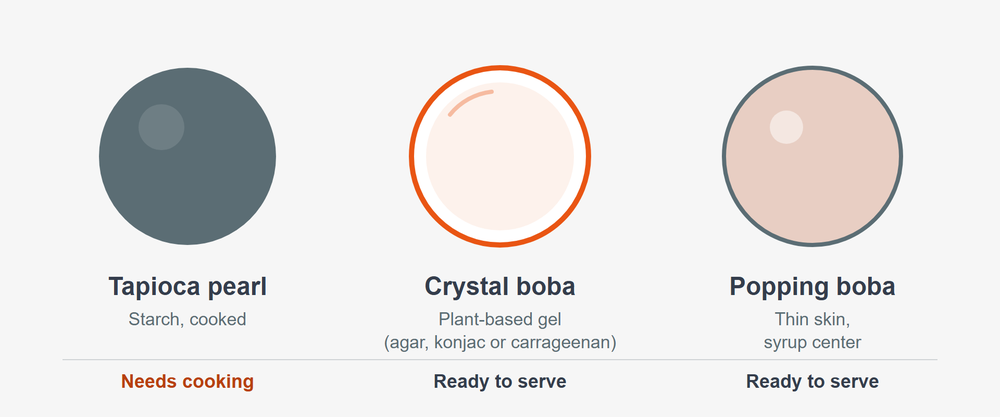
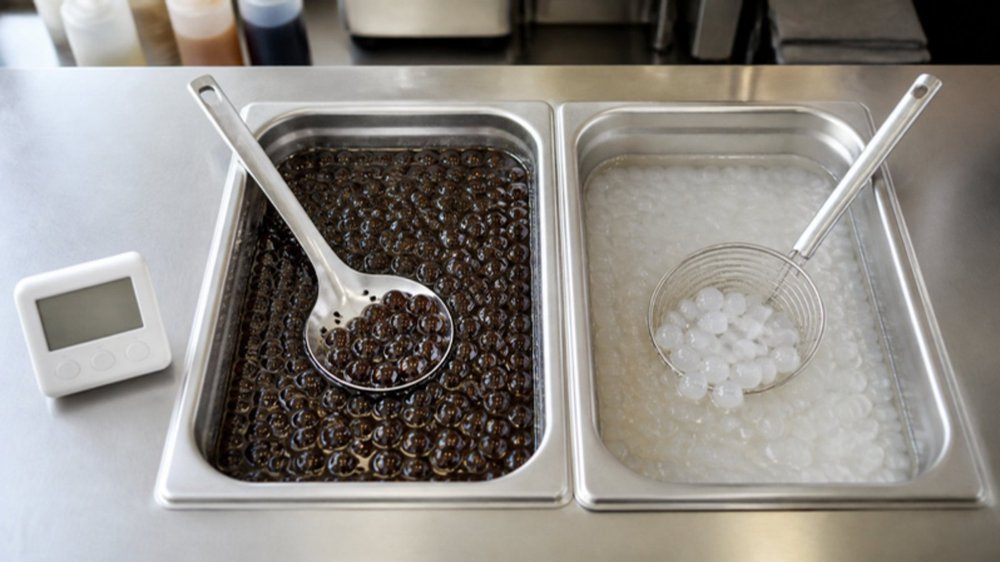
Crystal boba skips the cooking step that tapioca pearls require. Dry tapioca pearls are boiled, rested and sweetened in batches, and cooked tapioca pearls should be served or discarded within four hours at room temperature. Commercial crystal boba is usually sold ready to serve in syrup, so a shop scoops it, drains it and serves. The bite differs as well: tapioca pearls are soft and sticky, and crystal boba is springier and cleaner. A shop that wants to cut batch cooking from its line can move one drink to crystal boba without changing the base recipe. BubblePhil's tapioca pearls cover the classic side of the menu.
Crystal boba is solid gel all the way through, and popping boba is a thin skin around syrup. Both are ready to serve, but they behave differently in the cup. Popping boba bursts when bitten and suits fruit tea and sparkling drinks, while crystal boba keeps its shape and holds up in milk tea as well. Heavy milk tea tends to mask the flavor of popping boba, so it is a weaker fit there. Browse BubblePhil's popping boba range for the burst-in-the-mouth option. For popping boba against tapioca pearls, see Boba vs Pearl vs Popping Boba.
Crystal boba is easiest to place on a menu where the drink needs texture but not a strong flavor of its own. Because it takes on the syrup it sits in, one flavor can serve several drinks.
BubblePhil's eight crystal boba flavors come with these drink matches:
All eight flavors come in the same carton format of 2 kg × 6 bags. For hot drinks, sticking and clumping, and how long an opened bag keeps, brands differ and public sources conflict, with claims ranging from one day to three. Some suppliers, for example, recommend refrigerating after opening and using within 48 hours. Rather than trusting a general rule, put five questions to every supplier:
Send those five questions with your first inquiry and the answers will tell you more than any comparison article can. The supplier's food safety certificates deserve the same scrutiny, and BubblePhil's guide, How to Verify a Bubble Tea Ingredient Supplier's Food Safety Certification, explains how to check the ones a supplier shows you.
Shop owners and buyers tend to ask the same four questions about crystal boba.
Crystal boba and tapioca pearls differ in main ingredient, but both usually come sweetened, and most of the calories in a serving come from the syrup and the portion size. Published calorie figures for crystal boba vary widely and most carry no source, so the nutrition label on the specific product is the only reliable comparison.
Agar, konjac and carrageenan are all plant-derived, so crystal boba is commonly plant-based rather than gelatin-based. Added ingredients differ by brand, so read the label for the product you plan to buy.
Commercial crystal boba is usually sold ready to serve and does not need cooking. Follow the supplier's instructions for rinsing and draining, because they vary.
No. Crystal boba is solid gel, and popping boba is a thin skin around syrup. The cross-section table in the comparison section above shows the difference.
Gelling agent, shelf life after opening and serving size all vary from one crystal boba to the next, and they belong on a spec sheet rather than in an article. Send BubblePhil the flavors you are considering, the drinks they will go into and your rough monthly volume, and the team can return specifications and a quotation for its eight crystal boba flavors.
Contact BubblePhil and use the Inquiry Content box to list your flavors, your drinks and your monthly volume. Distributors and brands planning private-label crystal boba can start with BubblePhil's collaboration process. For background on working with a manufacturer that handles development and production in-house, see What Is a Bubble Tea Manufacturing Integrator?
Want to see more from BubblePhil in Google Search? Add BubblePhil as a preferred source.