Opening a bubble tea shop takes three to six months and, on published estimates, somewhere between $30,000 and $200,000 for an independent storefront. The number that decides whether you are still open in month seven is none of those. It is the one most startup guides compress into a single line: who supplies your tapioca pearls, syrups and powders, and what you asked them for before the first container shipped.
A bubble tea franchise trades control for speed: you pay an upfront fee and ongoing royalties, and in return the brand, the menu and usually the supplier are already chosen for you. That is a real benefit if you have never run a beverage counter, and it is also why franchise margins sit lower over five years and why a franchisee cannot reformulate a drink for local taste without approval.
Building your own brand costs more attention and less money up front: you choose the menu and the supplier, and every decision below is yours. The steps that follow assume that path.
Published estimates for opening an independent boba shop run from roughly $30,000 to $200,000. The range is that wide not because the estimates are careless, but because every shop differs in format, location and build-out standard. Any published figure is a reference point, not a substitute for a budget you have worked out yourself.
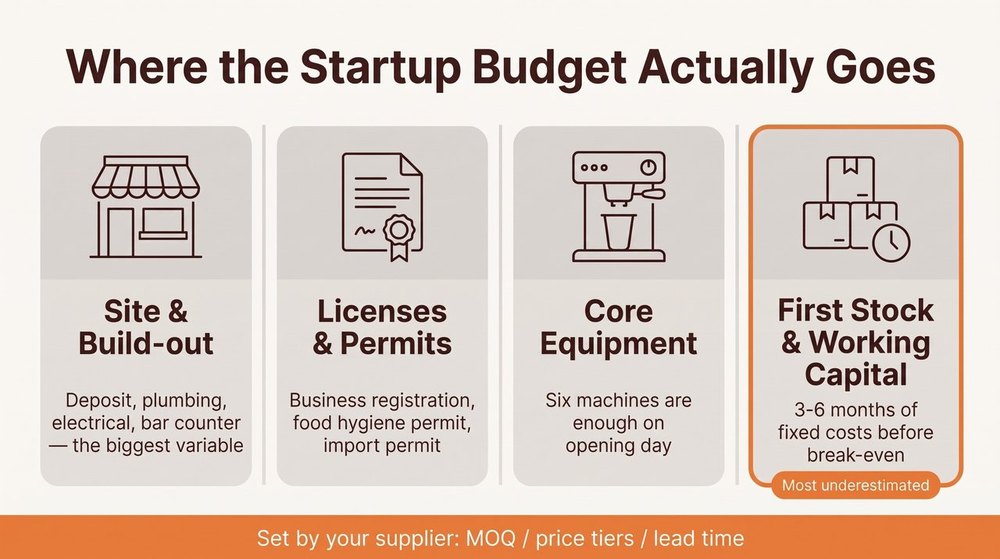
Rather than borrowing someone else's number, start by seeing which of the four cost categories you actually control:
Of the four, the last is the one new owners most often underbudget. It is not a number you calculate on your own; it is set directly by the terms your supplier offers you: minimum order quantity, price tiers and lead time. How to ask a supplier for those three things is covered in the sourcing section below.
A bubble tea business plan earns its keep in three sections: who you are selling to, what is on the menu, and what that menu forces you to buy every month. Everything else in the document is for a lender or a landlord.
Those three sections run in sequence, each narrowing the next. Your customer profile sets the location and store format; the store format caps how many menu items you can execute at peak hour. The menu, in turn, produces a specific ingredient list (pearl format, syrup flavors, powder types, topping range), and that list is what you take to a supplier. A plan that stops at "sell bubble tea to students near campus" has not yet told you what to order.
Store format, location and menu size are one decision made three times, because each one sets the limits of the other two. A takeout-only counter needs less space and fewer staff than a dine-in shop, which changes both your lease budget and your peak-hour throughput. Most people who open a bubble tea shop start takeout-only for that reason and add seating later.
Menu size is the constraint people underestimate: every additional drink category adds an ingredient to hold, a prep step to train, and a line item that can expire. Launch narrow. Adding a seasonal fruit tea with popping boba in month four is straightforward; removing six slow sellers after you have already bought the inventory is not. Once the menu is fixed, the next constraint stops being commercial and becomes legal.
Selling bubble tea legally takes three separate approvals in most markets, and the third one catches new owners late. The first is business registration. The second is a food business or health department permit, usually with a premises inspection covering handwashing, refrigeration and waste.
The third applies the moment your ingredients cross a border. Most bubble tea ingredients are manufactured in Taiwan, so unless you buy through a local distributor you are importing food, and that puts you under your own country's import rules rather than your supplier's.
Choosing a bubble tea ingredient supplier comes down to three questions you can answer before you commit: what documents they will send you, what your destination market requires, and how small a first order they will accept. Most startup guides reduce this to one instruction: find a reliable supplier. Then they move on to marketing. The three subsections below are what "reliable" actually resolves to.
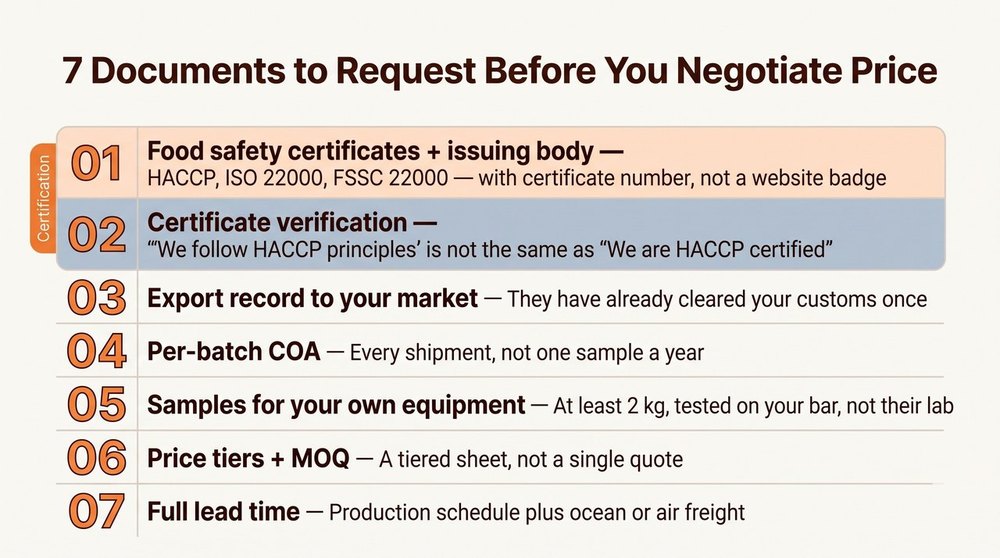
Ask a bubble tea ingredient supplier for seven things in writing before you discuss price:
BubblePhil publishes a full four-stage supplier evaluation framework covering documentation review, sample testing and factory audit, along with how to verify those certificates yourself. Both are worth reading before your first supplier call.
Your destination market sets requirements your supplier cannot see, and they change what you need to ask for. FSSC 22000, HACCP and ISO 22000 are the standards most commonly required for import compliance in the US, EU, Japan and South Korea.
Beyond that shared baseline, each market adds its own. The US goes further, requiring FDA registration of the foreign facility plus FSVP compliance, as noted in the licensing section above. Japan and South Korea apply stricter microbial limits to imported food ingredients than most other markets. Markets with large Muslim populations will expect HALAL certification, and some buyers, particularly in the United States, will ask for KOSHER documentation and the name of the certifying agency.
Whichever market you are importing into, the question to put to a supplier is narrow: have you shipped here before, and can you produce the documents this market asks for?
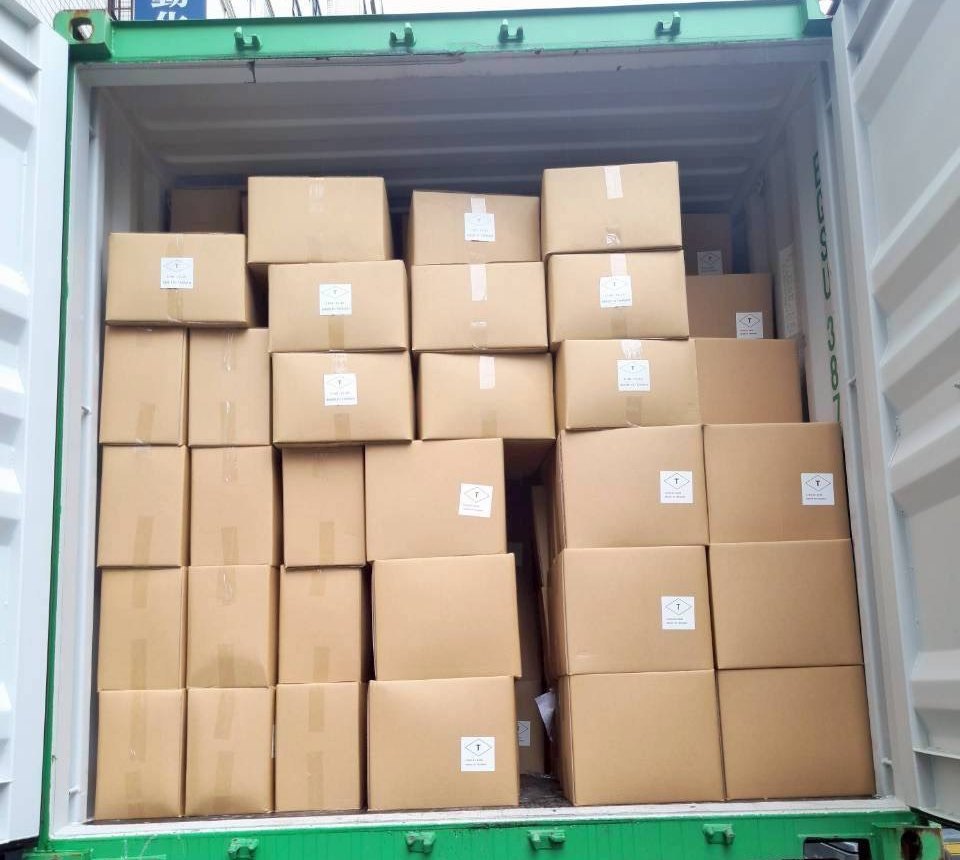
Minimum order quantities for tapioca pearls typically range from 200kg to 1 metric ton per order, depending on the manufacturer's production scale, and original equipment manufacturer (OEM) or original design manufacturer (ODM) programs usually start higher, at around 500kg to 2 metric tons per stock-keeping unit (SKU). Those are industry-wide figures published in BubblePhil's supplier guide, not a quote.
For a single new shop, that range is the whole problem, and there are three ways around it. Smaller operators can often negotiate lower MOQs through a regional distributor rather than ordering direct from the factory. Mixed cases let you spread a minimum across three or four flavors instead of committing to one. And a sample order costs almost nothing (2kg is enough for meaningful testing) and tells you whether the conversation is worth continuing.
To compare formats before you ask, see our wholesale tapioca pearls.
If you want a straight answer for your own volume, ask a supplier directly: the smallest workable shipment is a question they can answer in one reply.
Pearl format sets your daily prep labor before it sets anything else. Dry tapioca pearls arrive uncooked and must be boiled, then steeped in syrup before service. BubblePhil's official cooking chart runs from 5 minutes of boiling plus 10 minutes of steeping for spec 1.5 mini pearls (about 5mm) up to 30 minutes of boiling plus 35 minutes of steeping for spec 2.5 boba pearls (about 8mm), followed by a syrup soak of roughly 10 to 20 minutes. Instant formats, frozen or room temperature, skip the boil entirely and are ready within minutes.
That difference compounds across a service day, because cooked pearls do not keep. Cooked tapioca pearls held at room temperature should be served or discarded within four hours, which means a shop running dry pearls is cooking in batches all day rather than once each morning.
Three practical specifications follow from this. Standard commercial pearls are around 8mm, with mini pearls near 5mm for blended and slush formats. Dry pearls ship in cases of 3kg × 6 bags or 1kg × 20 bags, store below 30°C (86°F) away from direct sunlight, and should be used within three days of opening once refrigerated. Lower-quality pearls start losing their chew within 90 to 120 minutes of cooking, which is the clearest practical signal of raw material quality you can test yourself.
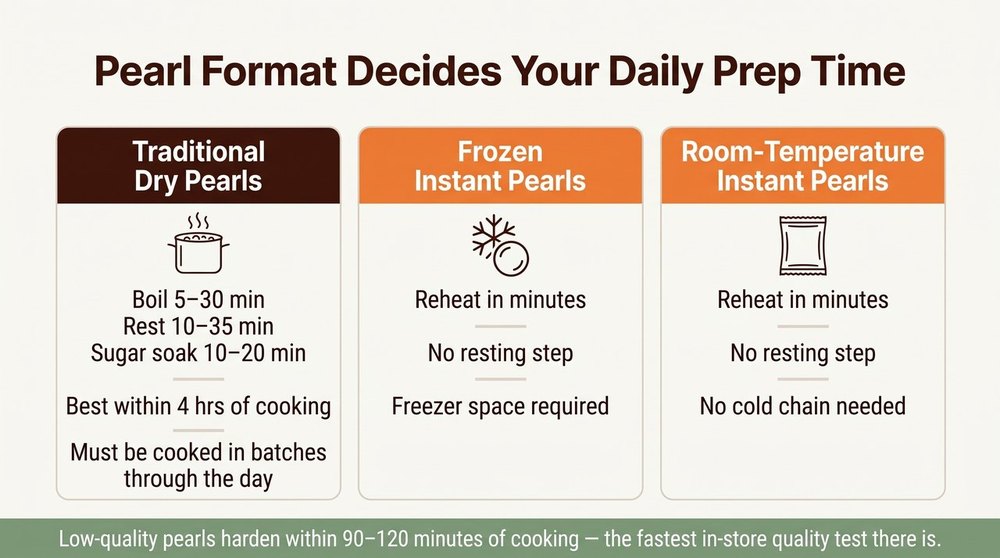
If your prep window is the constraint rather than your budget, compare Frozen Instant Pearls and Room Temperature Instant Pearls before you commit to a format, and check the full specifications for each against your opening hours. That choice also decides whether a pearl cooker or a warmer belongs on your equipment list.
Six pieces of equipment cover a standard bubble tea menu on opening day, and everything else can wait until you know which drinks actually sell: a cup sealing machine, a pearl cooker or warmer, a tea brewer, a fructose dispenser, a cup shaker, and refrigeration with an ice supply.
Match the sealing machine to your cup diameter before ordering film: that mismatch stops service entirely. BubblePhil supplies bubble tea equipment alongside ingredients, which keeps the cup, film and sealer specifications aligned from one source. With the counter equipped, the last job before opening day is demand.
Marketing a bubble tea shop starts four to eight weeks before opening day, and the soft-opening period is worth more as product research than as revenue. Tease the opening locally, run it with a deliberately short menu, and record what people order and what they leave unfinished.
That record is your first real input for a supplier conversation. Sweetness level, pearl texture and topping preference vary sharply by market, and a manufacturer with in-house research and development (R&D) can adjust a formulation once you can tell them what your customers actually ordered.
A few questions come up almost every time someone is planning a first shop:
Q : Is owning a bubble tea shop profitable? Profitability depends on four variables you control: ingredient cost as a share of revenue, rent and labor, how tightly drinks are standardized, and waste. Standardization matters more than owners expect, because an inconsistent recipe raises ingredient cost and lowers repeat orders at once.
Q : Do you need a license to sell boba tea? Yes, and the order matters more than the count. The health permit is tied to the premises, so it cannot be issued until you hold the lease, which means a lease signed before you have checked the local requirements can leave you paying rent on a site that fails inspection.
Q : How much do bubble tea owners make? Owner income varies too widely by market, store format and volume for a single figure to be meaningful. The three variables that move it most are daily cup volume, ingredient cost per cup, and rent as a share of revenue.
Q : What is the most popular bubble tea brand? Brand leadership differs by market, and in most countries no single chain dominates. For a new independent shop the more useful question is what separates your menu from the chain two blocks away, which usually comes down to ingredient quality.
Q : Does my shop need HALAL or KOSHER certification? Your shop usually does not; your ingredients might. These are supplier-side certifications that travel with the product, so the question to answer is whether your customers or your local regulator expect the ingredients to carry them. If they do, ask the supplier for the certificate and the name of the certifying agency, because an uncertified batch cannot be retroactively certified after it ships.
This guide can tell you what to ask a supplier. It cannot tell you what your own first order should look like, because that depends on your menu, your daily cup volume and the market you are importing into.
Those three inputs change the answer completely. A 40-cup-a-day stand and a 300-cup-a-day storefront importing into South Korea need different pearl formats, different pack sizes and different paperwork.
Send us those three things and we will come back with a workable product mix and the export documents your market needs. In the Inquiry Content box on our contact form, tell us:
As a Taiwan bubble tea supplier, BubblePhil has manufactured tapioca pearls and popping boba in Taoyuan, Taiwan for over 30 years under HACCP, ISO 22000, FSSC 22000, HALAL and Kosher certification, and ships to 19 markets. Our Business Startup Services team also covers brand positioning, menu setting, beverage marketing strategy and bar training if you would rather have the whole opening handled together.
Already working with a supplier and looking for a stable second source, or an existing customer who needs a new point of contact? Say so in the inquiry form and our export team will pick it up directly.